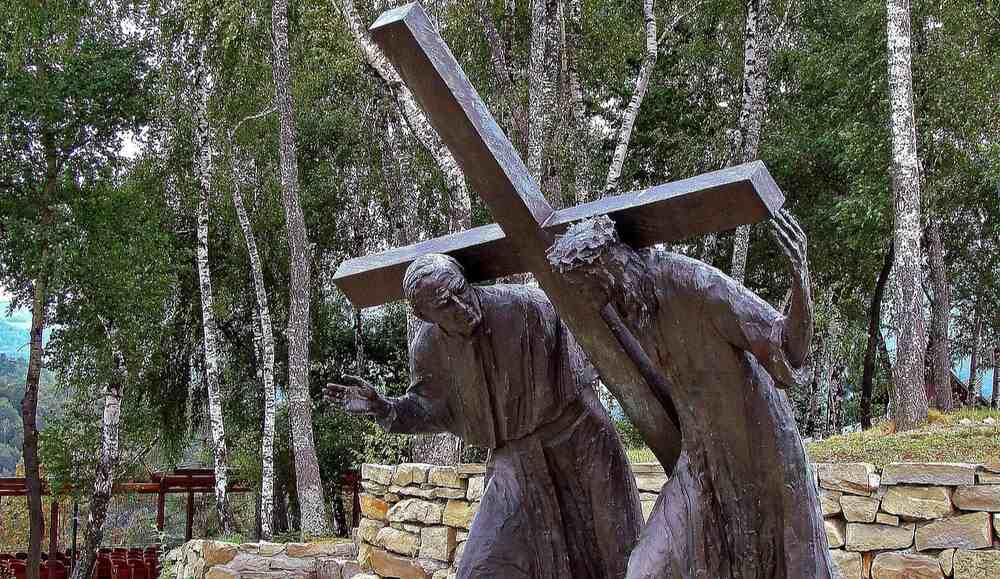
Holy Tuesday, also known as the Sixth Tuesday of Lent, is part of Holy Week, a time when Christians continue preparing for the main celebrations of the Paschal Triduum.
On Holy Tuesday, the Church invites us to reflect on the announcements of the Lord’s Passion. The text, taken from the Gospel of John (Jn 13:21-33, 36-38), recounts how Jesus tells his disciples that one of them will betray him and warns Peter about his denial.
If we follow the chronological order of Holy Week, we know that on Holy Tuesday Jesus returned to Jerusalem. After spending the night in Bethany, he and his disciples go back to the city. They see the fig tree that had been cursed the day before, now dried up from the roots, and then head to the Temple in Jerusalem, where Jesus teaches and confronts the chief priests, scribes, and elders. For this reason, H oly Tuesday is known as the Tuesday of controversy, because it commemorates Jesus’ final confrontation with the teachers of the law. There he denounces their hypocrisy and impiety.
Later, he goes with his disciples to the Mount of Olives, where he foretells the destruction of Jerusalem and his future coming.
In addition to the liturgical celebration, in many countries and cities Holy Tuesday continues with various expressions of popular devotion, especially processions organized by confraternities and brotherhoods that make their way through the streets.
Biblical Readings for Holy Tuesday
1. First Reading: Isaiah 49:1-6
Listen to me, distant coastlands; pay attention, far-off peoples! The Lord called me from my mother’s womb; from my mother’s belly he spoke my name. He made my mouth like a sharp sword; he hid me in the shadow of his hand. He made me a sharpened arrow; he concealed me in his quiver. He said to me: “You are my servant, Israel, through whom I will be glorified.” But I said: “I have toiled in vain; for nothing, uselessly, I have spent my strength.” Yet my right is with the Lord, and my recompense is with my God. And now the Lord has spoken—he who formed me from the womb to be his servant, to bring Jacob back to him and gather Israel to him. I am honored in the eyes of the Lord, and my God has been my strength. He says: “It is too little that you should be my servant to raise up the tribes of Jacob and bring back the survivors of Israel; I will make you a light to the nations, that my salvation may reach to the ends of the earth.”
2. Responsorial Psalm: Psalm 70:1-4a, 5-6ab. 15. 17
R. My mouth will proclaim your salvation, Lord.
In you, Lord, I take refuge;
let me never be put to shame!
In your justice, rescue me and deliver me;
incline your ear to me, and save me.R.
Be for me a protecting rock,
you who have decided to always come to my help,
for you are my Rock and my fortress.
Deliver me, my God, from the hands of the wicked!R.
For you, Lord, are my hope
and my security since my youth.
In you I have relied from my mother’s womb;
from my mother’s belly you have been my protector.R.
My mouth will proclaim unceasingly
your acts of justice and salvation,
though I cannot even count them.
My God, you taught me from my youth,
and to this day I have told of your wonders.R.
- You might be interested in: 7 Holy Places to See in Jerusalem
3. Gospel: John 13:21-33, 36-38
While Jesus was at table with his disciples, he was deeply troubled and declared openly: “Amen, amen, I say to you, one of you will betray me.”
The disciples looked at one another, at a loss as to whom he meant.
One of his disciples—the one whom Jesus loved—was reclining close to Jesus. Simon Peter motioned to him and said, “Ask him whom he means.” He leaned back against Jesus and asked him, “Lord, who is it?”
Jesus answered, “It is the one to whom I will give the morsel after I have dipped it.”
So he dipped the morsel and gave it to Judas, son of Simon Iscariot. After Judas took the morsel, Satan entered him. Jesus said to him, “What you are going to do, do quickly.”
Now none of those at table understood why he said this to him. Since Judas kept the common purse, some thought that Jesus was telling him, “Buy what we need for the feast,” or that he should give something to the poor. So, after receiving the morsel, he immediately went out. And it was night.
After Judas left, Jesus said: “Now the Son of Man has been glorified, and God has been glorified in him. If God has been glorified in him, God will also glorify him in himself, and he will glorify him at once. My children, I will be with you only a little while longer. You will look for me, and as I told the Jews, so I tell you now: ‘Where I am going, you cannot come.’”
Simon Peter said to him: “Lord, where are you going?”
Jesus answered: “Where I am going, you cannot follow me now, but you will follow later.”
Peter asked him: “Why can’t I follow you now? I will lay down my life for you.”
Jesus answered: “Will you lay down your life for me? Amen, amen, I say to you, the rooster will not crow before you have denied me three times.”
Holy Tuesday: Reflection by St. Alphonsus Maria de Liguori
Then the chief priests and the Pharisees convened the council and said: What are we to do? This man is performing many signs (Jn 11:47). While Jesus was busy pouring out graces and working miracles for the benefit of all, the leading figures of the city were plotting the death of the author of life. Caiaphas, the impious high priest, said: It is better that one man should die for the people than that the whole nation should perish (Jn 11:50). And from that day on, St. John continues, they thought of nothing but how to put him to death.
While the chief priests were deliberating, Judas appears and says to them: What will you give me, and I will hand him over to you? (Mt 26:15). Great must have been the joy that seized the Jews—those wicked enemies of Christ—when they saw that one of his own disciples was ready to betray him and deliver him into their hands. This joy would mirror that other joy that must exist in Hell when a soul that has been in Christ’s service abandons him and betrays him for a vile interest, for a poisoned pleasure.
But look, Judas: since you are willing to sell your God, at least ask the price of his worth. He is an infinite good; his price, therefore, must be infinite. But you—do you close the deal for thirty pieces of silver? My unfortunate soul, forget Judas for a moment and think of yourself; tell me, at what price have you so many times sold the grace of God to the devil?
O my Jesus! I am ashamed to appear in your presence when I remember the insults I have done to you. How many times I have despised you for a whim, for a fleeting and vile pleasure! I knew well that by sinning I lost your friendship, and yet I willingly renounced it for a trifle. If only I had died before causing you so great an outrage! My Jesus, I repent of it with all my soul and would like to die of sorrow.
Let us admire here the kindness of Jesus Christ. He is not unaware of the devilish plot Judas has just made, and yet he does not dismiss him from his company nor look at him with indignation; rather, he welcomes him as a friend and seats him at his table. And if he speaks to him of his infamous betrayal, it is so that he may come to his senses; and when he sees him stubborn in evil, he humbles himself in his presence and lowers himself to wash his feet to soften his heart.
O my Jesus! I see that you do the same with me: I have despised you, I have betrayed you, and yet you have not denied me your friendship. You look on me with tender eyes and admit me to your Eucharistic banquet. Why, most beloved Savior, have I not always returned your love? How can I ever again turn away from you and renounce your love?
- You may be interested in: Meditations on the Passion by St. Alphonsus Maria de Liguori


What are the lessons of Holy Tuesday?
The announcement of the denial of Peter the Apostle in the Gospel of John (Jn 13:21-33, 36-38) is one of the most significant moments the Church wants us to reflect on during Holy Tuesday.
Here are some lessons to reflect on this day:
1. Never rely on your own strength:
Peter confidently claims he is ready to give his life for Jesus. Yet the Lord tells him he will deny him three times before the rooster crows. This episode reminds us that initial fervor or good intentions are not enough unless they are accompanied by awareness of our weakness and of our need for God’s grace to remain faithful at all times.
Let’s ask ourselves: Do I rely too much on my own strength to remain faithful to Christ? Am I aware of my fragility, or do I think I could never fail?
2. Christ knows our weaknesses before we fall
Jesus foretells Peter’s denial before it happens. In doing so, he shows that he knows the human heart deeply. Yet he does not reject him or remove him from his mission. The Lord sees our weaknesses with love and mercy. He continues to call us to follow him.
Let us reflect: When I sin, do I trust in God’s mercy and beg his forgiveness with true repentance and the resolve not to sin again?
3. Sin often comes from fear:
Peter does not deny Jesus out of hatred, but out of fear. Fear of persecution, social rejection, or suffering can lead Christians to hide their faith or act against it.
Let’s consider: In what situations am I ashamed to live out, publicly proclaim, or defend my faith?
4. The Lord always forgives us:
Peter’s story does not end with the denial. After his fall, he will repent and follow the Lord again—so much so that he will give his life for him. It shows us that sin does not have the last word when there is sincere repentance.
Let us meditate: When I fall, do I seek to return to God with humility, or do I remain paralyzed by guilt?
This episode should encourage us to trust the Lord completely, to rest in him with full awareness that only his grace can sustain us to be faithful at all times.
Do you want to live Holy Week with devotion? Here are some articles that may help you do so:
- Holy Week Timeline: Discover what Holy Week is, what happened each day, and how to live the Paschal Triduum according to the Catholic Church. A clear, complete guide.
- The 3 Pillars of Palm Sunday: What is the Palm Sunday liturgy like? Explore its 3 pillars: the blessing of palms, the procession, and the Passion narrative.
- What Did Jesus Do on Holy Monday?: Let’s follow in the Redeemer’s footsteps. Let us reflect on what he did on Holy Monday.
- What does the Bible say about Holy Wednesday?: Want to know what happened on Holy Wednesday? Read the Gospel and reflect with St. Augustine.
What is celebrated on Holy Tuesday?
Holy Tuesday is part of Holy Week and continues the spiritual preparation for the Paschal Triduum. On this day, the Church recalls the announcements that Jesus Christ makes to his disciples about the events that will precede his Passion, especially the betrayal of Judas Iscariot and the denial of Peter the Apostle.
What happened on Holy Tuesday according to the Bible?
According to the Gospels, after spending the night in Bethany, Jesus returns to Jerusalem with his disciples. Along the way they see the fig tree that had been cursed the day before, now dried up from the roots. Then Jesus teaches in the Temple in Jerusalem and confronts the chief priests, scribes, and elders. Later he goes to the Mount of Olives, where he speaks to his disciples about the destruction of Jerusalem and his future coming.
What did Jesus do on Holy Tuesday?
On Holy Tuesday, Jesus taught in the temple, answered the questions of the religious authorities, and denounced the hypocrisy of some teachers of the law. He also instructed his disciples about future events and the need to remain watchful in faith.
What is done on Holy Tuesday in the Catholic Church?
In the Catholic Church, Holy Tuesday is observed as a day of prayer, reflection, and preparation for the central days of Holy Week. In many parishes, Mass is celebrated with the readings proper to the day, and in many places there are processions and acts of popular devotion organized by confraternities and brotherhoods.
What reflection does Holy Tuesday leave us with?
Holy Tuesday invites us to reflect on fidelity to Christ and human fragility. The announcements of betrayal and denial show that even the closest disciples can fail, but they also remind us of the importance of conversion, spiritual vigilance, and trust in God’s mercy.
Where can I find Holy Tuesday Masses near me?
The Mass Times app allows you to locate nearby Catholic churches and check Mass, confession, and adoration times in real time.
When is Holy Tuesday 2026 celebrated?
In 2026, Holy Tuesday will be celebrated on 31 March. This day is part of Holy Week, which culminates with Easter Sunday, when the Church celebrates the resurrection of Jesus Christ.