Devotion to Our Lady of Sorrows, also known as Mater Dolorosa, is one of the pillars of Marian piety in the Church, especially during Lent and Holy Week. In it, the believer’s gaze rests upon the mystery of Redemption, where Mary, by divine design, participates in a singular way in the sacrifice of her Son, Jesus Christ. Throughout the centuries, this devotion has generated a rich heritage of prayers and pious exercises, promoted by saints and approved by the Church as effective means of sanctification.
The meditation on the Seven Sorrows is the devotional practice par excellence of this advocation. These episodes, fundamentally based on the Gospels, trace Mary’s life from Jesus’ infancy to his burial. In them, we contemplate how suffering was a constant accepted out of love for the redemptive mission. It is not a sterile suffering, but an active and offered compassion, intimately united to the sacrifice of Christ.
Among the most widespread ways to meditate on these mysteries is the Rosary of Our Lady of Sorrows, also called the Rosary of the Seven Sorrows or the Rosary of Sorrows. Unlike the traditional Dominican rosary, it consists of seven groups of seven Hail Marys — septenaries — each preceded by the meditation of a sorrow and the recitation of an Our Father. Its purpose is to invite the believer to “lend their heart” to Jesus to love Mary as He loves her and to ask the Mother to help us grasp the gravity of sin and to embark on a path of radical conversion.
But, specifically, what does the Rosary of Our Lady of Sorrows consist of and how is it prayed? We tell you in this article!
Devotion to Our Lady of Sorrows
Devotion to Our Lady of Sorrows is based on the profound union of hearts between the Mother and her Son, Jesus Christ. The Church teaches that Mary was not a distant spectator of the Passion, but participated interiorly in Christ’s redemptive suffering. Her sorrow was part of God’s salvific design. As the New Eve, her faithful obedience cooperated with the work of redemption where sin had introduced death.
The Roman Pontiffs have affirmed that the Virgin suffered spiritually alongside her Son. By accepting the immolation of Christ, she lovingly renounced her maternal rights and fully united her will to that of the Redeemer. Therefore, tradition speaks of a singular cooperation of Mary in redemption: always subordinate to Christ, the sole Savior, but truly associated with his sacrifice. This participation was announced by the elder Simeon when he prophesied that a sword would pierce her soul (cf. Lk 2:35).
The culmination of this union occurs at the foot of the Cross. The Gospel presents her standing firm — Stabat — beside the Crucified. In that supreme hour, Jesus entrusts his Mother to the beloved disciple and, in him, to all humanity. Thus, Mary, associated with the redemptive sacrifice through her compassion and suffering, becomes the spiritual Mother of the faithful. Venerated as “suppliant omnipotence,” her power does not come from herself, but from her intimate union with Christ and her constant intercession on behalf of the Church.
Therefore, the Sorrowful Mother teaches that suffering is not useless if united to the divine will, because it can save souls. Thanks to faith, we can remain “standing” in the face of adversity. Hope in the resurrection gives meaning to the cross.
The 7 Sorrows of the Virgin
The meditation on the Seven Sorrows was spread by the Order of the Servants of Mary, founded in the 13th century. The Servites promoted this devotion with the desire to spiritually accompany the Mother in her solitude and contemplate her union with the mystery of Redemption. Over time, the Church officially recognized this practice: in 1423, the Synod of Cologne instituted a celebration in honor of the sorrows of the Blessed Virgin.
The Seven Sorrows cover the most painful moments of Mary’s life, from Jesus’ infancy to his burial. Each reveals a dimension of her faith and her participation in her Son’s redemptive mission.
What are the 7 Sorrows of Mary?
1. The Prophecy of Simeon.
When Mary and Joseph present the Child in the Temple, the elder Simeon announces that a sword will pierce her soul (cf. Lk 2:35). This first sorrow is the wound of premonition: from that moment, Mary knows that her Son’s path will be marked by sacrifice.
2. The Flight into Egypt.
Warned in dreams, Saint Joseph must flee with Mary and the Child to escape Herod’s persecution. This sorrow represents exile and uncertainty. It teaches us to trust in God even amidst danger and precariousness.
3. The Loss of Jesus in the Temple.
For three long days, Mary anxiously searches for Jesus in Jerusalem. This sorrow reflects the desolation of the soul that fears having lost God and invites us to always seek Christ with perseverance.
4. The Meeting on the Way to Calvary.
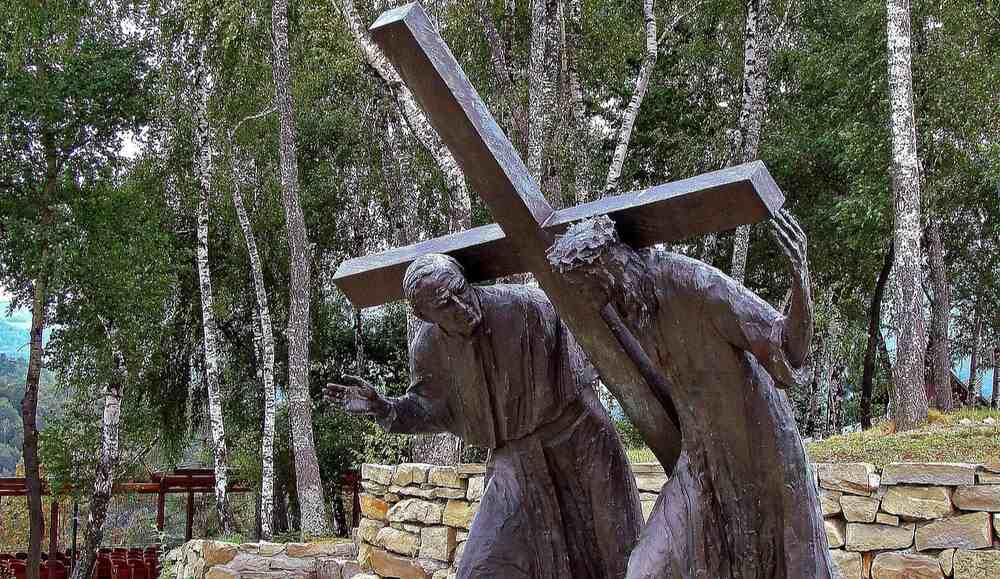
On the Via Dolorosa, the Mother meets her Son carrying the Cross. It is a silent exchange of glances, full of love and fidelity. Mary does not turn away from suffering, but remains by His side.
5. Jesus Dies on the Cross.
Mary stands at the foot of the Cross (Stabat). She contemplates the agony and death of her Son and offers her sorrow to the Father in union with the redemptive sacrifice. It is the most intense moment of her compassion.
6. Jesus is Taken Down from the Cross and Given to His Mother.
In the descent, Christ’s lifeless body is placed in Mary’s arms. This sorrow invites us to contemplate Jesus’ total surrender and His Mother’s silent strength.
7. The Burial of Jesus and the Solitude of Mary.
The body is placed in the tomb and the stone is sealed. Mary experiences the separation and silence of Holy Saturday. However, her faith does not waver: she hopes against all hope for the promised Resurrection.
Promises and Spiritual Benefits of the Devotion
The Church, through its saints and approved private revelations, has indicated that devotion to the Sorrows of the Virgin does not go without spiritual reward. It is considered a privileged means to obtain contrition for sins and the necessary strength at the hour of death.
The Seven Graces of Saint Bridget of Sweden
According to tradition, the Virgin Mary promised to grant seven graces to those souls who honor her daily by praying seven Hail Marys while meditating on her tears and sorrows:
- Peace in families: The homes of the devout will be free from discord.
- Spiritual enlightenment: Deep understanding of divine mysteries.
- Consolation in sorrows: Mary will accompany her devotees in their labors and afflictions.
- Petitions answered: Granting of what they ask, provided it is for their salvation.
- Defense in spiritual combat: Protection against the temptations of the infernal enemy.
- Assistance at death: Mary will be visibly present at the last moment of the faithful’s life.
- Eternal happiness: Those who spread this devotion will be taken directly to heaven after the forgiveness of their sins.
Promises of Jesus for Devotees of His Sorrowful Mother
Saint Alphonsus Maria de Liguori relates that Our Lord revealed to Saint Elizabeth of Hungary four additional special graces for devotees of Mater Dolorosa:
- Perfect contrition: Those who invoke the Mother in the name of her sorrows will obtain total forgiveness of their sins before dying.
- Protection in tribulation: Jesus will be the shield of these faithful in their most difficult moments.
- Memory of the Passion: Devotees will always keep Christ’s sacrifice in mind, which will serve as merit for heaven.
- Marian mediation: Jesus will entrust these souls to Mary so that she may dispose of all the necessary graces for their salvation.
Rosary of the Sorrows of Mary
An Our Father and seven Hail Marys are prayed for each sorrow of the Virgin. At the same time, we ask her to help us understand the evil we have committed and lead us to true repentance. By uniting our sorrows to Mary’s, just as she united her sorrows to those of her Son, we participate in the redemption of our sins and those of the whole world.
We begin praying the Rosary with an Act of Contrition:
My Lord, Jesus Christ, I deeply repent of all my sins. I humbly beg Your forgiveness and through Your grace, grant me to be truly worthy of Your love, through the merits of Your Passion and Your death and through the sorrows of Your Most Holy Mother. Amen.
(It is advisable to read the Gospel passages that accompany each sorrow)
First Sorrow – The Prophecy of Simeon (cf. Luke 2:22-35)
How great was the impact on Mary’s Heart when she heard the sad words with which Simeon prophesied the bitter Passion and death of her sweet Jesus. Dear Virgin of Sorrows, obtain for me a genuine repentance for my sins.
-Our Father, seven Hail Marys, Glory Be to the Father.
Second Sorrow – The Flight into Egypt (Matthew 2:13-15)
Consider the sharp pain Mary felt when she and Joseph had to flee suddenly at night, in order to save their beloved Son from the slaughter decreed by Herod. How much anguish Mary suffered, how many were her privations during such a long journey. How much suffering she experienced in the land of exile. Sorrowful Mother, obtain for me the grace to persevere in trust and abandonment to God, even in the most difficult moments of my life.
-Our Father, seven Hail Marys, Glory Be to the Father.
Third Sorrow – The Child Lost in the Temple (Luke 2:41-50)
How agonizing was Mary’s sorrow when she realized she had lost her beloved Son. Full of worry and fatigue, she returned with Joseph to Jerusalem. For three long days they searched for Jesus, until they found him in the temple. Mater Dolorosa, when sin leads me to lose Jesus, help me to find him again through the Sacrament of Reconciliation.
–Our Father, seven Hail Marys, Glory Be to the Father.
Fourth Sorrow – Mary Meets Jesus on the Way to Calvary (Fourth Station of the Way of the Cross)
Come near, dear Christian, come and see if you can bear such a sad scene. This Mother, so sweet and loving, meets her Son amidst those who drag him to such a cruel death. Consider the tremendous pain they felt when their eyes met – the pain of the blessed Mother trying to support her Son. Virgin of Sorrows, I too want to accompany Jesus in His Passion, help me to recognize Him in my suffering brothers and sisters.
-Our Father, seven Hail Marys, Glory Be to the Father.
Fifth Sorrow – Jesus Dies on the Cross (John 19:17-39)
Contemplate the two sacrifices on Calvary – one, the body of Jesus; the other, the heart of Mary. Sad is the spectacle of the Mother of the Redeemer seeing her beloved Son cruelly nailed to the cross. She remained at the foot of the cross and heard her Son promise heaven to a thief and forgive His enemies. His last words addressed to her were: “Mother, behold your son.” And to us He said in John: “Son, behold your Mother.” Mary, I accept you as my Mother and I always want to remember that You never fail your children.
-Our Father, seven Hail Marys, Glory Be to the Father.
Sixth Sorrow – Mary Receives the Body of Jesus When Taken Down from the Cross (Mark 15:42-46)
Consider the bitter pain that Mary’s Heart felt when the body of her beloved Jesus was taken down from the cross and placed on her lap. Oh, Sorrowful Mother, our hearts tremble at the sight of such affliction. Grant that we may remain faithful to Jesus until the last moment of our lives.
-Our Father, seven Hail Marys, Glory Be to the Father.
Seventh Sorrow – Jesus is Placed in the Sepulchre (John 19:38-42)
Oh Mother, so afflicted! Since in the person of the apostle Saint John you welcomed us as your children at the foot of the cross, and that at the cost of such bitter sorrows, intercede for us and obtain for us the graces we ask of you in this prayer. Obtain for us, above all, oh tender and compassionate Mother, the grace to live and persevere always in the service of your most beloved Son, so that we may deserve to praise Him eternally in heaven.
-Our Father, seven Hail Marys, Glory Be to the Father.
Final Prayer
Oh Sorrowful and Immaculate Heart of Mary, dwelling of purity and holiness, cover my soul with your maternal protection so that, always faithful to the voice of Jesus, I may respond to His love and obey His divine will. I want, my Mother, to live intimately united to your Heart which is totally united to the Heart of your Divine Son. Bind me to your Heart and to the Heart of Jesus with your virtues and sorrows. Protect me always. Amen.
Good Friday of Sorrows
Good Friday of Sorrows, celebrated one week before Good Friday, acts as the spiritual gateway to Holy Week. On this day, we turn our gaze to Our Lady of Sorrows. On this day, the Sanhedrin, or supreme Jewish council, met to conspire and decide Jesus’ death sentence. By extension, popular piety associates this day with the beginning of Mary’s public suffering, who, upon learning of the Sanhedrin’s intentions against her Son, begins her path of bitterness.
Liturgically, Good Friday of Sorrows is characterized by a sobriety that prepares the spirit for the mysteries of the Passion. In many parishes, the sequence of the Stabat Mater is included in the celebration of the Eucharist, and the practices of fasting and abstinence from red meat, typical of Lenten Fridays, are maintained.
In the realm of confraternities, this day marks the beginning of processional outings in numerous cities.
Hymn Stabat Mater
The sorrowful Mother stood
by the cross and wept
while her Son hung there.
Whose soul, sad and tearful,
pierced and sorrowful,
held a fierce sword.
Oh, how sad and how afflicted
the blessed Mother was,
filled with so many torments!
When sadly she contemplated
and sorrowfully beheld
the suffering of her beloved Son.
And what man would not weep,
if he beheld the Mother
of Christ, in such great sorrow?
And who would not be saddened,
Pious Mother, if he saw you
subjected to such rigor?
For the sins of the world,
the sweet Mother saw Jesus
in such profound torment.
She saw her beloved Son die,
who, forsaken, yielded
his spirit to his Father.
Oh sweet fount of love!
Make me feel your sorrow
so that I may weep with you.
And that, for my beloved Christ,
my burning heart
may live more in Him than in me.
And, that I may be moved to love Him,
imprint in my heart
the wounds He bore.
And of your Son, Lady,
share with me now
those He suffered for me.
Make me weep with you
and truly grieve
for His pains while I live.
For I desire to accompany
your compassionate heart
on the cross, where I see Him.
Oh Virgin of virgins most holy!
May I weep now with such longing,
that weeping may be sweet to me.
So that His passion and death
may be in my soul, in such a way
that I may always see His pains.
Make His cross enamor me
and may I live and dwell in it
as a sign of my faith and love.
So that it may inflame and ignite me,
and with you defend me
on the day of judgment.
Make the death of Christ protect me,
when in such a strong
ordeal life and soul are.
So that, when the body rests in peace,
my soul may go
to His eternal glory. Amen.


How many lessons Our Lady of Sorrows teaches us!
She shows us that human suffering ceases to be useless when united to the sacrifice of Christ. Just as Mary participated in the Redemption in a singular way, the faithful can offer their own sorrows as an act of love for souls and cooperation in the salvation of the world. It is the price of love for a God crucified out of love for us.
The figure of Our Lady of Sorrows at the foot of the Cross (Stabat Mater) teaches that faith requires the fortitude to remain “standing” in the face of adversity. Suffering becomes a school of strength where the believer finds companionship and strength in Mater Dolorosa not to be “crushed” by tribulations.
Most Holy Mary knew the Scriptures and perfectly understood all that the Messiah had to suffer. Despite this, she did not cower, but accepted God’s plan. With her fiat at the Annunciation and at the foot of the cross, she shows us that suffering must be a renewed “yes” to God’s will, even when we do not immediately understand the reason for the suffering.
Devotion to Our Lady of Sorrows reminds us that suffering is not the final destination. Mary, though heartbroken, maintained hope in the victory over death. Thus, Christian suffering becomes the necessary path that precedes the glory of the Resurrection.
How important it is to meditate on her sorrows throughout the year, but especially during this Lenten season! Let us implore Our Lady of Sorrows for the grace of horror for sin and a renewed ardor in the combat for our sanctification.
Want to live Lent with devotion? Here are some articles that may help you do so:
- All about Ash Wednesday: Do you want to start Lent in the best possible way? Gather your heart, meditate and participate in the Ash Wednesday Liturgy!
- What is Lent and why does it last 40 days?: Discover what Lent is, why it lasts 40 days, when it begins, and how to live this liturgical season with its beautiful spiritual practices.
- 4 Tips from Don Bosco for Lent: Do you want to live this Lent with fervor? Do you want it to be a time of great spiritual growth? Follow these tips from Don Bosco!
What are the 7 Sorrows of Our Lady of Sorrows?
Christian piety contemplates seven key episodes in Mary’s life that represent her path of suffering alongside Jesus:
- The Prophecy of Simeon: The announcement that a sword would pierce her soul.
- The Flight into Egypt: The exile to save the Child’s life from Herod’s persecution.
- The Loss of Jesus in the Temple: The anguish of searching for Jesus for three days in Jerusalem.
- The Meeting with Jesus on the Way to Calvary: The exchange of glances on the Via Dolorosa.
- The Crucifixion and Death of Jesus: Mary remains at the foot of the Cross at the moment of sacrifice.
- The Descent from the Cross: When Jesus’ lifeless body is given to His Mother.
- The Burial of Jesus and the Solitude of Mary: The final mourning after placing the body in the tomb.
How can I pray to Our Lady of Sorrows?
She can be invoked as “Comforter of the Afflicted,” asking her for strength to face adversities and meaning for one’s own suffering. A traditional way to ask her is to pray her Rosary of the Seven Sorrows, asking her to “lend us her Heart” to love Jesus as she loves Him.
What do the 7 swords of Our Lady of Sorrows mean?
The seven swords that usually pierce the heart of the image are a visual representation of the prophecy of the elder Simeon (“a sword will pierce your soul”).
When should the Rosary of the 7 Sorrows be prayed?
Although it can be prayed at any time of the year (especially on Saturdays), the Church particularly recommends its practice during Lenten Fridays, Good Friday of Sorrows (the Friday before Palm Sunday), and September 15, the day of her official liturgical feast.
How is the Rosary of the 7 Sorrows prayed?
Unlike the traditional rosary, this one is structured in septenaries:
- It optionally begins with an Act of Contrition.
- The first sorrow is announced and briefly meditated upon.
- An Our Father, seven Hail Marys, and a Glory Be are prayed.
- This process is repeated for each of the seven sorrows.
- At the end, three Hail Marys are usually prayed in honor of the tears shed by the Virgin Mary.
What is the history of Our Lady of Sorrows?
The veneration of Mary’s compassion began to be documented around the 10th century under titles such as “Queen of Martyrs.”