Are you traveling to Barcelona? Here is a guide to the 9 best churches in Barcelona, Spain, that you simply can’t miss.
If you’d like to visit all of them, we recommend staying in the city for at least two or three days. You can follow the itinerary below, which has been designed according to the geographical proximity of the churches, making it easy to move around either on foot or by public transport. Along the way, you’ll also have the chance to explore nearby historical and cultural landmarks. The route covers churches dating from Roman times to the present day.
Day 1 focuses on the Gothic Quarter and the coastal area, the historical heart of Christianity in Barcelona.
Day 2 takes you through Eixample, El Raval, and Mount Tibidabo, home to some of the city’s most impressive 19th- and 20th-century churches.
An optional Day 3 is included for a pilgrimage to Montserrat, one of the most important spiritual destinations in Catalonia.
Day 1: Gothic Quarter and Coastal Area
For the first day of this church itinerary in Barcelona, we suggest a walking route through the Gothic Quarter and the nearby coastal area, ideal for discovering the city’s Christian origins without long distances or major transfers.
The day begins in the southern part of the Gothic Quarter with visits to the Basilica of Santa Maria del Pi and the Basilica of Saints Justus and Pastor, two key examples of Catalan Gothic architecture and landmarks of early Christianity in Barcelona. The distance between them is just a five-minute walk, allowing you to enjoy the historic surroundings at a relaxed pace.
In this same area, you’ll find Plaça del Rei, the Royal Major Palace, and the Barcelona History Museum (MUHBA), where you can explore archaeological remains of ancient Barcino, the Roman city that preceded modern Barcelona. Very close by stands the former Hospital of the Holy Cross, now home to the Library of Catalonia, one of the most important medieval civic buildings in the city.
At midday, the itinerary continues into the heart of the Gothic Quarter with a visit to the Cathedral of the Holy Cross and Saint Eulalia (La Seu), the seat of the Archbishop of Barcelona and one of the city’s most iconic religious monuments. The visit can be complemented by a walk across the Bishop’s Bridge and past the Casa de l’Ardiaca, two historic sites closely linked to the cathedral complex.
In the afternoon, the route heads toward the coastal area to visit the Basilica of Santa Maria del Mar, one of the finest and purest examples of Catalan Gothic architecture, followed by the Basilica of Our Lady of Mercy, a sanctuary dedicated to Barcelona’s patron saint.
Nearby, you’ll find the Born Market, medieval remains of the former port district, the Picasso Museum, and the Santa Caterina area, all ideal for rounding out the cultural experience.
This part of the city can be reached via Metro Line L4 (Born station) or with a pleasant walk from the Gothic Quarter. The total distance covered during the day is approximately 3 kilometers on foot, combined with short public transport rides.
To end the day, the El Born neighborhood offers a wide range of dining options, making it an excellent place for dinner and a well-deserved rest.
1. Basilica of Santa Maria del Pi

© Basílica de Santa María del Pi – Barcelona
Vista de la nau/ Vista de la nave/ View of the nave – Photo: Raimón Solá
https://basilicadelpi.cat/es/postales-del-pi/
The Basilica of Santa Maria del Pi is a minor basilica located in the historic center of Barcelona. It is considered one of the city’s most important churches due to its antiquity, religious significance, and architectural value. Its origins date back to the early centuries of Christianity, and tradition places a Christian place of worship on this site as early as the 5th century. It was likely built over a Roman necropolis located outside the walls of ancient Barcino.
The church is reliably documented from the year 987 as a Romanesque parish. According to a 16th-century tradition, the image of Our Lady of the Pine was discovered inside the trunk of a pine tree near the Roman walls of Barcelona, on the very site where the present church stands. The image was reportedly found by a fisherman who had cut down the tree to build a boat.
Construction of the current building began in the early 14th century, during a period of urban and commercial expansion under the Crown of Aragon. Work continued throughout the century and was completed in 1391, although the church was not consecrated until 1453.
Together with the Cathedral of Barcelona, Santa Maria del Mar, and Saints Justus and Pastor, Santa Maria del Pi forms part of the group known as the four great Gothic churches of Barcelona.
From an architectural perspective, Santa Maria del Pi is a distinguished example of Catalan Gothic architecture, characterized by its structural sobriety and the solid, compact nature of its volumes. The main façade is especially notable for its large rose window, one of the biggest in Catalan Gothic, as well as for its austere and monumental appearance.
Over the centuries, the church was enriched with altarpieces, archives, and works of art. However, much of this heritage was lost during periods of conflict, particularly in the fire of 1936, at the beginning of the Spanish Civil War.
Following several restoration campaigns, Santa Maria del Pi regained both its liturgical and cultural role. In 1925, it was granted the title of minor basilica, and in 1931, it was declared a Cultural Heritage Site. Today, it remains one of the most significant churches in Barcelona, valued for both its historical depth and artistic importance, and is a regular stop on church itineraries throughout the city.
- For more information about this church, visit the official website of the Basilica of Santa Maria del Pi.
- Location: Plaça del Pi, 7, Ciutat Vella, 08002 Barcelona, España.
2. Basilica of Saints Justus and Pastor

The Basilica of Saints Justus and Pastor is a Gothic church located in the Ciutat Vella district, in the historic heart of Barcelona. It is considered one of the churches in Barcelona with the longest continuous tradition of Christian worship.
According to tradition, its origins date back to the 4th century, on an ancient promontory known as Mont Justi, where a Roman sacred site likely existed and was later Christianized. Continuous Catholic worship at this location has been documented since at least the 6th century.
In 801, the Frankish king Louis the Pious promoted the reconstruction of the church. In the 10th century, it was consecrated to the martyr saints Justus and Pastor. During the Middle Ages, its parish included key institutional spaces such as the Palau Reial Major (Royal Palace), which explains the strong support it received from the Barcelona nobility.
Construction of the current Gothic building began in 1342, on the site of a former Romanesque church, and continued until 1574, making it the last of Barcelona’s great Gothic churches. The façade was rebuilt in Neo-Gothic style at the end of the 19th century. In 1948, Pope Pius XII granted the church the title of minor basilica.
The interior stands out for its 16th-century stained-glass windows, the structural austerity characteristic of Catalan Gothic, and the layering of artistic styles resulting from its long history. The current main altar is Neoclassical (19th century), and the basilica preserves important works of art, including the Altarpiece of the Passion by Pere Nunyes, one of the most significant works of the Catalan Renaissance.
Dedicated to Saints Justus and Pastor, 4th-century martyrs during the persecution of Diocletian, the basilica is today one of the most meaningful churches in Barcelona, Spain, valued for its religious, historical, artistic, and cultural importance. It is also a regular stop for pilgrims visiting the city.
- For more information about the Basilica of Saints Justus and Pastor, visit its official website.
- Location: Plaça de Sant Just, s/n, Ciutat Vella, 08002 Barcelona, España.
3. Cathedral of the Holy Cross and Saint Eulalia

By Mromanchenko – Cathedral of the Holy Cross and Saint Eulalia.jpg, CC BY-SA 3.0, https://commons.wikimedia.org/w/index.php?curid=114472572
The Cathedral of the Holy Cross and Saint Eulalia, also known as Barcelona Cathedral, is located in the heart of the Gothic Quarter, in the historic center of the city, and serves as the seat of the Archdiocese of Barcelona. It is one of the most significant churches in Barcelona from both a historical and religious perspective.
The present cathedral was built between the 13th and 15th centuries on the site of an earlier Romanesque cathedral, which itself stood over a Visigothic church, preceded by a paleochristian basilica. Remains of these earlier structures can be visited today in the underground level of the Barcelona History Museum (MUHBA). Although the main structure is medieval, the imposing façade—designed in the same Gothic style—was completed much later, in the 19th century.
The cathedral has been dedicated to the Holy Cross since the year 599, and from 877 onward it was also dedicated to Saint Eulalia, patron saint of Barcelona. Saint Eulalia was a young Christian martyr of the 4th century who, according to tradition, endured thirteen torments—corresponding to her thirteen years of age—for denouncing the persecution of Christians before the Roman governor and refusing to renounce her faith. Her relics rest in the cathedral’s crypt, one of the most important devotional spaces among the churches of Barcelona.
Architecturally, the cathedral follows a Latin cross plan with three naves. Among its most remarkable features are the 14th-century Gothic choir, richly carved and located in the center of the main nave, and the 14th-century cloister, one of the most iconic areas of the complex. Thirteen white geese live in the cloister, symbolizing Saint Eulalia’s age at the time of her martyrdom. From the cathedral terrace, visitors can enjoy panoramic views of the Gothic Quarter and the historic center of Barcelona.
The cathedral also features five entrances, twenty-seven chapels dedicated to various saints, and houses the tombs of kings and queens of Aragon as well as counts of Barcelona. Without a doubt, it is one of the most important churches in Barcelona.
- For more information about this church, visit the official website of Barcelona Cathedral.
- Location: Pcta. de la Seu, s/n, Ciutat Vella, 08002 Barcelona, España.
4. Basilica of Santa Maria del Mar
By Kent Wang – Own work, CC BY-SA 4.0, https://commons.wikimedia.org/w/index.php?curid=150785385
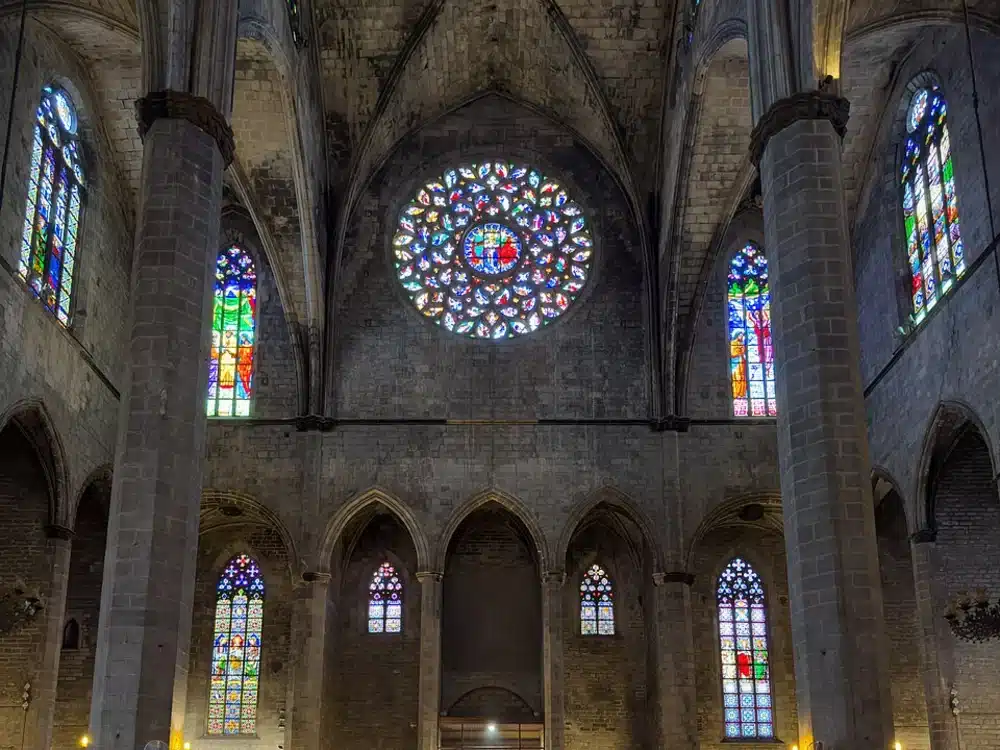
The Basilica of Santa Maria del Mar is a minor basilica located in the Ribera district of Barcelona and is one of the city’s most representative churches due to its close connection with Barcelona’s social and maritime history. For nearly seven centuries, this church has borne witness to the city’s medieval splendor and to some of the most significant episodes in its history.
Construction of Santa Maria del Mar began in 1329, in the heart of the 14th century, at a time when Barcelona was establishing itself as one of the leading powers of the Mediterranean thanks to the maritime expansion of the Crown of Aragon. At that time, the Ribera neighborhood was home to sailors, merchants, and guilds linked to port activity, who promoted the construction of a new church to replace the old Romanesque parish church, which had become insufficient for a growing population. The project was led by master builders Berenguer de Montagut and Ramon Despuig.
The church was completed in just 54 years—an exceptional timeframe for a Gothic church—thanks to the collective effort of local authorities, guilds, and neighborhood workers.
From an architectural perspective, Santa Maria del Mar is one of the purest examples of Catalan Gothic, characterized by sobriety, harmonious proportions, and a strong sense of spatial unity. Its interior stands out for the spaciousness of the nave, the minimal distance between pillars, and the absence of excessive ornamentation, creating an open and balanced space. Natural light, filtered through its stained-glass windows, enhances the atmosphere of contemplation and solemnity.
Throughout its history, the basilica has suffered several episodes of destruction, the most severe being the fire of 1936 at the outbreak of the Spanish Civil War, which caused significant damage to its interior heritage. Since then, continuous restoration and conservation efforts have been carried out to preserve this temple, considered one of the great religious and cultural symbols of the city.
In 1923, Pope Pius XI granted it the title of minor basilica, a recognition that consolidated its religious importance among the churches of Barcelona.
- For more information about this church, visit the official website of the Basilica of Santa Maria del Mar.
- Location: Plaça de Santa Maria, 1, Ciutat Vella, 08003 Barcelona, España.
5. Basilica of Our Lady of Mercy

By Canaan – Own Work, CC BY-SA 4.0, https://commons.wikimedia.org/w/index.php?curid=112622381
The Basilica of Our Lady of Mercy and Saint Michael the Archangel, commonly known as the Basilica of La Mercè, is a minor basilica located in Plaça de la Mercè, in Barcelona’s Gothic Quarter. It is dedicated to Our Lady of Mercy, patron saint of the city and of the Archdiocese of Barcelona.
The origins of the church date back to the 13th century, when Saint Peter Nolasco founded the Order of Mercy on this site, an order devoted to the redemption of Christian captives. In 1249, authorization was granted to build a church dedicated to Saint Mary next to the Mercedarian convent on land near the port. Over time, popular devotion came to identify the church as that of Mare de Déu de la Mercè, in reference to the charitable mission of the order.
The original medieval church, built in the Gothic style, was expanded between the 14th and 15th centuries. Due to the growth of both devotion and the city itself, it was decided in the 18th century to replace it with a new building. The present basilica was constructed between 1765 and 1775.
From an architectural point of view, the church reflects a Baroque style with strong Italian influence, characterized by its monumental scale.
The high altar houses the venerated Gothic image of Our Lady of Mercy, dated to 1361 and attributed to the sculptor Pere Moragues. It is one of the most important devotional works of Catalan Gothic art. The dome is crowned by a bronze sculpture of the Virgin Mary.
The basilica suffered severe damage during the Spanish Civil War (1936), but underwent an extensive process of restoration throughout the 20th century. It was granted the title of minor basilica in 1918, and in 2018 the 800th anniversary of the foundation of the Order of Mercy was celebrated, marking the return of the Mercedarians to the pastoral care of the church.
Today, the Basilica of La Mercè is an essential landmark among the churches of Barcelona, valued both as a Marian shrine and for its artistic, historical, and urban significance. It is also a key stop on church and religious tourism itineraries in Barcelona.
- For more information about this church, visit the website of the Basilica of Our Lady of Mercy.
- Location: Carrer de la Mercè, 1, Ciutat Vella, 08002 Barcelona, España.
Día 2: Eixample, Raval y Tibidabo
For the second day of the itinerary through the churches in Barcelona, we propose a broader route that combines Catalan Modernism, medieval Romanesque architecture, and one of the city’s great urban sanctuaries. This day connects the city center with its higher areas, offering a comprehensive view of the spiritual, artistic, and landscape diversity of Barcelona, Spain.
In the morning (9:00–13:00), the route begins in the Eixample district with a visit to the Expiatory Temple of the Sagrada Familia, the most emblematic church in Barcelona and one of the most important in the world. Very close by is the Hospital de Sant Pau, whose Modernist Site, declared a UNESCO World Heritage Site, allows visitors to complement the visit with one of the most outstanding modernist civic complexes in Europe. Due to the high number of visitors, it is recommended to book tickets for the Sagrada Familia in advance.
At midday (13:30–15:00), the itinerary moves to the Raval neighborhood to visit the Monastery of Sant Pau del Camp (Saint Paul of the Countryside), one of the best-preserved examples of Romanesque architecture in Barcelona. This former Benedictine monastery, founded in the Early Middle Ages, offers a striking contrast to the modernism of the morning and provides insight into the city’s monastic origins. Nearby are the Barcelona Museum of Contemporary Art (MACBA) and the Centre for Contemporary Culture of Barcelona (CCCB), two key cultural institutions. Access from the Sagrada Familia can be made via metro line L3, with an approximate travel time of 20 minutes.
In the afternoon (15:30–18:00), the route concludes on Mount Tibidabo, the highest point in the city, with a visit to the Expiatory Temple of the Sacred Heart of Jesus, one of Barcelona’s great sanctuaries. This monumental church, visible from many points in the city, offers not only a place of devotion but also privileged panoramic views over Barcelona and the Mediterranean Sea. Nearby is the historic Tibidabo Amusement Park, one of the oldest in Europe. Access can be made by bus 196 from Plaça Catalunya or by combining public transport with the Tibidabo funicular, making the journey itself part of the experience.
6. Expiatory Temple of the Sagrada Familia

By Canaan – Own work, CC BY-SA 4.0, https://commons.wikimedia.org/w/index.php?curid=113178560
Designed by architect Antoni Gaudí, construction of the Basilica of the Sagrada Familia began in 1882 and continues to this day, making it one of the most singular architectural works in the world. Among the churches of Barcelona, it is by far the most visited in Spain and one of the most frequented in Europe, surpassed only by St. Peter’s Basilica in the Vatican.
Its style, rooted in Catalan Modernism and enriched by Gothic and naturalistic influences, is profoundly symbolic and theological, conceived to convey the mysteries of Christianity through architecture itself.
The basilica follows a Latin cross plan, with five central naves, a three-nave transept, and an apse surrounded by seven chapels. Its three monumental façades are dedicated to key moments in the life of Christ:
-
the Nativity Façade, celebrating the Incarnation and the mystery of hiden life;
-
the Passion Façade, marked by stark forms that express the drama of sacrifice;
-
and the Glory Façade, still under construction, representing eternal glory and the human journey toward God.
The project includes a total of eighteen towers: twelve dedicated to the Apostles, four to the Evangelists, one to the Blessed Virgin Mary, and the central tower in honor of Jesus Christ, which will reach a height of 172.5 meters. Once completed, it will make the Sagrada Familia the tallest church in the world. The complex is completed by two sacristies flanking the apse and three major chapels dedicated to the Assumption, Baptism, and Penance.
In 2010, Pope Benedict XVI consecrated the temple as a minor basilica, reaffirming its religious and liturgical significance beyond its artistic value. Since then, Mass has been celebrated at the high altar; previously, liturgical celebrations were held only in the crypt.
Gaudí devoted the final fifteen years of his life almost exclusively to this project, fully aware that he would not live to see its completion and that its construction would extend across generations. Indeed, the Sagrada Familia is an expiatory temple, financed entirely through donations and conceived as a true “Bible in stone,” in which every architectural element carries a spiritual meaning.
The interior of the basilica is one of its most striking features: branching columns resemble trees, creating the sensation of standing within a stone forest; natural light, filtered through richly colored stained-glass windows, shifts throughout the day and deepens the symbolic power of the space; and the strong verticality draws both the gaze and the spirit upward toward the transcendent.
The Nativity Façade and the crypt—both built during Gaudí’s lifetime—have been declared UNESCO World Heritage Sites, firmly establishing the Sagrada Familia as an essential landmark among the churches of Barcelona and as one of the most important works of contemporary religious architecture.
- For more information about this church, visit the official website of the Basilica of the Sagrada Familia.
- Location: Carrer de Mallorca, 401, Eixample, 08013 Barcelona, España.


7. Monastery of Sant Pau del Camp (Saint Paul of the Fields)

By PMRMaeyaert – Own work, CC BY-SA 3.0 es, https://commons.wikimedia.org/w/index.php?curid=17433916
The Monastery of Sant Pau del Camp (San Pablo del Campo) is an ancient Benedictine monastery located in the Raval district of Barcelona and one of the finest preserved examples of Romanesque architecture in the city. Its origins date back to the late 9th century and are traditionally linked to Count Wifred II Borrell, whose tomb, dated to the year 911, is preserved within the monastery grounds.
Because it stood outside the medieval city walls, the monastery was repeatedly exposed to attacks, most notably the devastation inflicted by Almanzor in 985, after which it was abandoned for a period of time. Restoration began in the 11th century, and the monastery was later incorporated as a priory under several major monastic centers, including Sant Cugat, Montserrat, and La Portella. It reached its period of greatest prosperity in the 17th century, before the monastic community finally left the site in 1835.
Throughout the 19th and early 20th centuries, the complex served various civil and military purposes. It suffered further damage during the Tragic Week of 1909 and the Spanish Civil War in 1936, followed by successive restoration campaigns. In 1879, it was officially declared a National Monument.
Architecturally, the monastery is especially renowned for its 13th-century Romanesque cloister, modest in scale yet rich in detail, with lobed arches resting on paired columns and capitals carved with biblical, symbolic, and vegetal motifs. The church features a single nave with a Greek cross plan, three apses, a dome over the transept, and barrel vaults. The main portal preserves Visigothic marble capitals and a tympanum depicting Christ flanked by Saints Peter and Paul.
Today, the monastery functions as an active parish, with a particular focus on pastoral care for migrants, continuing its long tradition of service and hospitality.
- For more information about this church, visit the website of the Pastoral Community of Sant Pau del Camp.
- Location: Carrer de Sant Pau, 99, Ciutat Vella, 08001 Barcelona, España.
8. Expiatory Temple of the Sacred Heart of Jesus (Tibidabo)

© https://tibidabo.salesianos.edu/galeria-fotografica/#bwg1/22
The Expiatory Temple of the Sacred Heart of Jesus rises on the summit of Mount Tibidabo, the highest point in Barcelona, and stands as one of the city’s most powerful religious landmarks and visual icons. Its construction began in the late 19th century as a Catholic response to secular and Protestant projects planned for the mountain. A group known as the Board of Catholic Gentlemen acquired the land and, in 1886, entrusted it to Saint John Bosco, encouraged by the benefactress Dorotea de Chopitea, the principal patron of the project.
Devotion to the Sacred Heart of Jesus, strongly promoted by Pope Leo XIII, inspired the creation of an expiatory sanctuary, in harmony with other great European shrines such as the Sacré-Cœur in Paris. That same year, a Neo-Gothic hermitage was built—now incorporated into the complex—and in 1902 the cornerstone of the definitive temple was laid. Construction continued until 1961, initially under the direction of architect Enric Sagnier and later completed by his son, Josep Maria Sagnier.
Architecturally, the building reflects an eclectic historicist style, blending Neo-Romanesque, Neo-Gothic, and Neo-Byzantine elements, and is primarily constructed from Montjuïc stone. The complex is arranged on two levels: a lower crypt and an upper church, crowned by a great dome and topped by the monumental statue of the Sacred Heart of Jesus, a powerful symbol of protection watching over the city.
The crypt, inaugurated in 1911, is especially notable for its rich decorative program of mosaics, alabaster, and stained glass, dedicated to various Marian devotions and to the history of the sanctuary itself. From the crypt, visitors can access the Chapel of Perpetual Adoration, carved directly into the mountain. The symbolic ascent from the crypt to the statue of Christ embodies the theological meaning of expiation, purification, and spiritual elevation.
The upper church, built between 1915 and 1951, features three naves, numerous stained-glass windows, and sculptural representations of the Twelve Apostles, founding saints, and figures closely associated with devotion to the Sacred Heart. It was blessed in 1952 and officially completed in 1961.
In 1911, this Barcelona church was proclaimed Spain’s National Expiatory Temple, and on October 29, 1961, it was granted the title of minor basilica by Pope John XXIII. Today, it is recognized as a Cultural Asset of Local Interest.
- For more information about this church, visit the official website of the Salesians of Tibidabo.
- Location: Ctra. de Vallvidrera al Tibidabo, 111, Sarrià-Sant Gervasi, 08035 Barcelona, España.
Day 3: Excursion to Montserrat
If you have the chance to stay one extra day, do not miss the opportunity to make a pilgrimage to the Monastery and Sanctuary of Montserrat, one of the most important pilgrimage sites in Catalonia and in all of Spain. This visit beautifully crowns your journey through the churches in Barcelona.
Montserrat can be reached by taking the R5 train from Plaça Espanya, with a ride of approximately one hour, followed by the rack railway or the cable car up to the monastery complex.
Beyond the basilica and the Marian shrine, the site offers several complementary routes. The Sant Joan funicular provides access to scenic viewpoints and high-altitude trails, while the network of hermitage paths invites pilgrims to prayer, silence, and contemplation of the natural landscape.
9. Monastery and Sanctuary of Montserrat
By Jose Luis Filpo Cabana – Own Work, CC BY 3.0, https://commons.wikimedia.org/w/index.php?curid=29095246
The Sanctuary of Our Lady of Montserrat is one of the most important religious centers in Catalonia and Spain, and a place of uninterrupted pilgrimage since the Early Middle Ages. According to tradition, in the year 880 a group of shepherd children witnessed a heavenly light and heard angelic singing on the mountain. When they climbed to investigate, they found an image of the Virgin Mary inside a cave. According to legend, the image could not be moved, a sign of her desire to remain there. This event gave rise to devotion to La Moreneta, already documented in 1239, confirming the great antiquity of this Marian cult.
From that time onward, groups of monks began to settle in and guard the site. The Benedictine Monastery of Santa Maria de Montserrat was officially founded in 1025 under the leadership of Abbot Oliba, on the site of an earlier hermitage associated with Marian devotion. From the 12th century onward, Montserrat became firmly established as a major sanctuary, supported by donations and pilgrimages. Between the 12th and 13th centuries, the original Romanesque church was built.
Construction of the current basilica began in the 16th century, though it was largely rebuilt in the 19th century following the destruction suffered during the Peninsular War. In 1881, Pope Leo XIII granted it the title of minor basilica.
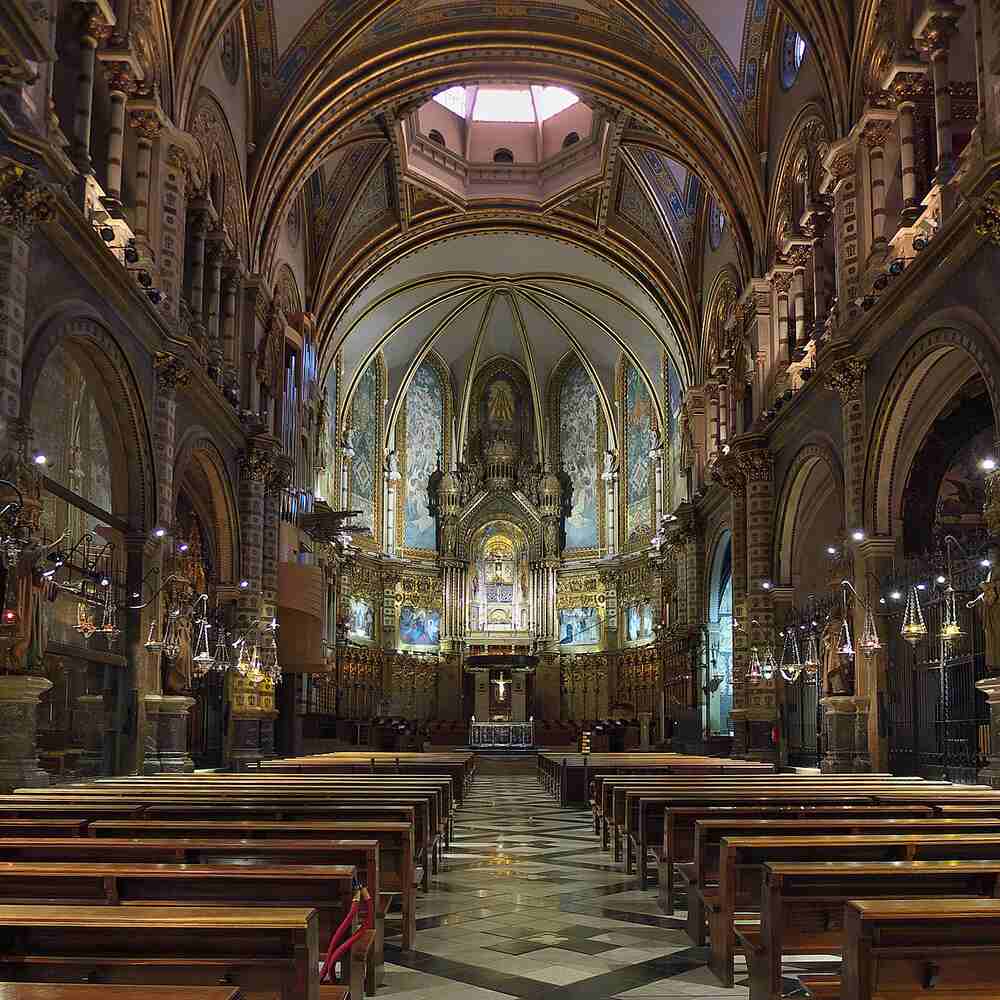
The basilica complex is organized around a large single-nave church, supported by columns adorned with sculptures of prophets and richly decorated with paintings, enamels, and works by prominent Catalan artists of the 19th and 20th centuries. Above the main altar stands the Marian shrine, which pilgrims ascend to visit—the true spiritual heart of the sanctuary. There, the Romanesque image of Our Lady of Montserrat is venerated, enthroned beneath a baldachin and surrounded by an extensive iconographic and artistic program.
The interior is completed by numerous side chapels, encompassing styles ranging from Romanesque to Modernisme and contemporary art, reflecting the monastery’s continuous history. Between 1991 and 1995, the entire complex underwent a comprehensive restoration, preserving its spiritual, artistic, and cultural heritage.
- For more information about this church, visit the website of the Monastery of Montserrat.
- Location: Q6HQ+PWC Jerusalem, Israel.
If you want to visit these churches, remember that your Catholic Mass Times app will be your best travel companion. It will help you find local Mass schedules, Confession services, and Adoration times, ensuring that your spiritual pilgrimage is always connected to the sacraments. Download it now.
Are you traveling to Spain and looking to visit more churches? Take a look at these articles to help you plan your journey:
- Top 7 of Churches to visit in Madrid: Discover some of the most impressive churches and basilicas in Spain.
- The 6 Most Visited Marian Shrines in the World: Learn more about the Basilica of Our Lady of the Pillar, the patron saint of Spain.
- 4 Relics of the Last Supper: Find out where the relics of the Holy Chalice and the tablecloth used at the Last Supper are kept in Spain.
- Where Are the Relics of the Passion of Christ?:Visit the Holy Shroud preserved in Oviedo.
Which are the most important churches to visit in Barcelona?</p> <p>
The most important churches in Barcelona include the Cathedral of the Holy Cross and Saint Eulalia, the Basilica of the Sagrada Família, Santa Maria del Mar, Santa Maria del Pi, the Basilica of Our Lady of Mercy, and the Expiatory Temple of the Sacred Heart on Tibidabo. These churches in Barcelona stand out for their historical, architectural, and religious significance, representing styles that range from Romanesque and Catalan Gothic to Modernisme.
How many days do you need to visit the churches in Barcelona?<br />
To explore the main churches in Barcelona, Spain, it is recommended to spend at least two full days. In two days, you can comfortably visit the Gothic Quarter, the waterfront area, the Eixample, El Raval, and Tibidabo. An optional third day allows for a pilgrimage to the Monastery and Sanctuary of Montserrat, one of the most important spiritual centers in Catalonia.
Can you attend Mass in the churches of Barcelona?<br />
Yes. Most churches in Barcelona maintain an active liturgical life and celebrate daily Mass, especially the Cathedral, the Sagrada Família, Santa Maria del Mar, and the city’s main sanctuaries. To check updated schedules for Mass, confession, and adoration, we recommend using the Catholic Mass Times app.
What is the best area to walk between churches in Barcelona?</p> <p>
The Gothic Quarter is the best area to explore several churches in Barcelona on foot. Within a short walking distance, you will find key temples such as Santa Maria del Pi, Saints Just and Pastor, Barcelona Cathedral, Santa Maria del Mar, and the Basilica of Our Lady of Mercy, along with historic squares, museums, and remains of ancient Barcino.
Which app helps you find Mass times in Barcelona?<br />
The Catholic Mass Times app allows you to locate nearby Catholic churches and check Mass, confession, and adoration schedules in real time during your trip.
Is Montserrat considered part of the churches of Barcelona?
Although Montserrat is not located within the city of Barcelona, it is often included in itineraries of churches in and around Barcelona due to its strong historical, spiritual, and cultural ties to the city. The Monastery of Montserrat, home to the Virgin of La Moreneta, is a major pilgrimage destination and a natural extension of a religious journey through Barcelona.