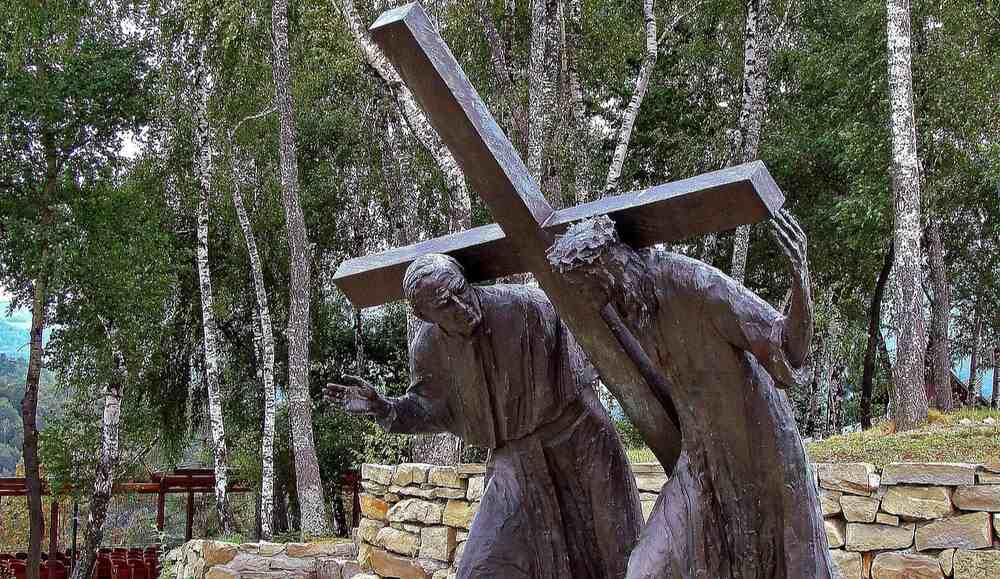
For pilgrims traveling to Jerusalem, it is an immense grace to walk the path where Jesus carried the cross for our salvation. This path is known as the Via Dolorosa or Way of Suffering. It stretches for about 900 meters, mostly uphill. It winds through the uneven, cobblestone stairs of Jerusalem’s Old City.
This journey gave rise to the devotion of the Stations of the Cross, so cherished by Catholics worldwide.
We do not know with absolute precision the exact route the Lord followed in the 1st century. We know that he was condemned in Fort Antonia and walked to Calvary, the place of crucifixion and burial, today identified with the Church of the Holy Sepulchre, which in Jesus’ time was outside the city walls.
The stations that today mark the Via Dolorosa take very diverse forms: some are indicated by small chapels along the way; others, by simple plaques or inscriptions on the walls. The pilgrim essentially moves through the heart of a living and bustling city, among shops, markets, and the constant murmur of daily life in the Middle East.
Far from being a distraction, this environment can become part of the prayer. Probably, when Christ walked this path carrying the cross, he was also surrounded by noise, commotion, and crowds.
Do you want to walk the Via Dolorosa and not get lost in the hustle and bustle? Here we share an interactive map with the detailed route through the 14 stations, the history of each, and some tips for your pilgrimage.
14 Stations of the Via Dolorosa
1. Church of the Flagellation

By Berthold Werner – Own work, CC BY-SA 3.0, https://commons.wikimedia.org/w/index.php?curid=16166889
Upon crossing the Lion’s Gate and leaving the Church of St. Anne behind, the pilgrim finds, to the left, a modern point marking the beginning of the Stations. A little further on, the First Station is traditionally located in the courtyard of the Omariye Arab College, a place identified with the ancient Fort Antonia, the fortress that dominated the Temple esplanade in Jesus’ time.
Here, we remember the moment when Pontius Pilate condemned the Lord, after he had been mocked and scourged by Roman soldiers. According to current custom, this space is usually opened especially on Fridays at three in the afternoon, when the Franciscans gather with the faithful to walk the Via Dolorosa.
However, the most accessible place to begin the Via Dolorosa journey on your own is the nearby Franciscan complex, where the Church of the Flagellation and the Chapel of Condemnation are located. They are situated within the monastery that also houses a biblical study center today.
The Chapel of the Flagellation dates back to the 12th century, although it was redesigned between 1927 and 1929 by the Italian architect Antonio Barluzzi, who preserved its sober and medieval style. It is a simple, single-nave space, with a vaulted ceiling supported by pillars. Above the altar, a dome with golden mosaics stands out, representing a crown of thorns pierced by stars, a symbol of Christ’s glorious suffering.
The stained-glass windows help pilgrims meditate on the mysteries remembered there: the flagellation, Pilate washing his hands, and the release of Barabbas.
The Gospel according to St. Matthew narrates this moment with startling sobriety:
“Pilate said to them, ‘What then shall I do with Jesus who is called Christ?’ They all said, ‘Let him be crucified!’ And he said, ‘Why, what evil has he done?’ But they shouted all the more, ‘Let him be crucified!’ So he released Barabbas to them; and having scourged Jesus, delivered him to be crucified” (Mt 27:22-23, 26).
- For more information about this Church, visit the website of the Custody of the Holy Land.
- Location: Q6JM+6MV Jerusalem, Israel.
2. Church of the Condemnation and Imposition of the Cross

By Tomere – Own work, CC BY-SA 4.0, https://commons.wikimedia.org/w/index.php?curid=43568211
The Second Station of the Via Dolorosa is located within the Franciscan compound of the Old City of Jerusalem, next to the Church of the Flagellation. Here stands the Church of the Condemnation and Imposition of the Cross, which commemorates the moment when Jesus, after being condemned, received the Cross on his shoulders.
Very close by, remnants of the ancient Arch of Ecce Homo are preserved, traditionally linked to the words spoken by Pontius Pilate when presenting Christ to the people. The arch visible today was part of a later Roman construction, erected during the time of Emperor Hadrian, after the fall of Jerusalem. In the area, vestiges of the ancient Roman pavement, called the lithostrotos, are also found, its grooved flagstones extending throughout the surroundings. On some stones, marks evoking ancient games can be seen, a tradition that has led to associating the place with the episode where the soldiers divided the Lord’s garments.
The current church, built in 1904 on medieval foundations and Byzantine remains, features an elevated and luminous structure, crowned by five white domes. Natural light descends from above, illuminating the altar, behind which an artistic representation shows Jesus being led from Fort Antonia to begin the journey to Calvary. Four pink pillars support the space, creating an atmosphere of contemplation and reflection.
Outside, a model of Jerusalem in the 1st century can be seen, which helps pilgrims understand that Golgotha was then outside the city walls.
The Gospel starkly describes what is meditated upon here:
“Then the soldiers of the governor took Jesus into the Praetorium, and they gathered the whole battalion before him. And they stripped him and put a scarlet robe on him, and twisting together a crown of thorns, they put it on his head. (…) And when they had mocked him, they stripped him of the robe and put his own clothes on him and led him away to crucify him” (Mt 27:27-31).
- For more information about this Church, visit the website of the Custody of the Holy Land.
- Location: Q6JM+6MV Jerusalem, Israel.
3. Armenian Chapel of the First Fall

By Anton – Own work, CC BY-SA 3.0, https://commons.wikimedia.org/w/index.php?curid=28490867
Continuing along the Via Dolorosa and after turning left, the pilgrim finds the Third Station near the intersection with El Wad Street. There, behind blue metal gates, stands a small chapel known as the Chapel of the First Fall or “Polish Chapel,” so named because its restoration in 1948 was financed by Polish soldiers who served in Palestine during World War II. The place belongs to the Armenian Catholic Patriarchate.
Above the arched entrance, a bas-relief can be seen depicting Jesus exhausted, bowed under the weight of the Cross. The image conveys the physical exhaustion and spiritual burden he carried: the sin of the world.
The chapel is small, narrow, and secluded, crowned by three domes. Inside, a moving composition of statue and mural shows Christ fallen to the ground, while angels gaze at him in sorrow. The words from the Book of Lamentations seem to resonate in this place:
“…a comforter who might revive me is far off” (Lam 1:16).
Although the Gospels do not explicitly describe Jesus’ falls, Christian tradition has meditated deeply on this moment in light of the prophet Isaiah:
“Surely he has borne our griefs and carried our sorrows; yet we esteemed him stricken, smitten by God, and afflicted. But he was wounded for our transgressions; he was crushed for our iniquities; upon him was the chastisement that brought us peace, and with his stripes we are healed. All we like sheep have gone astray; we have turned—every one—to his own way; and the Lord has laid on him the iniquity of us all” (Is 53:4-6).
- For more information about this holy place, visit the website of the Armenian Catholic Patriarchate.
- Location: Via Dolorosa, Jerusalem.
4. Chapel of the Swoon

By Anton 17 – Own work, CC BY-SA 3.0, https://commons.wikimedia.org/w/index.php?curid=28490897
By Anton 17 – Own work, CC BY-SA 3.0, https://commons.wikimedia.org/w/index.php?curid=28490897
By Anton 17 – Own work, CC BY-SA 3.0, https://commons.wikimedia.org/w/index.php?curid=28490897
A few meters from the Third Station, also to the left of the Via Dolorosa, is a small oratory that commemorates the moving encounter between Jesus and his Mother. The access is discreet: an arched gate with metal bars leading to an Armenian Catholic enclosure.
Above the entrance, a delicate lunette with a bas-relief chiseled by the Polish artist Zieliensky can be seen. The scene depicts Jesus and the Virgin Mary looking at each other with profound sorrow; Mary holds her Son’s wrist in a gesture of love and heartbreak.
This episode is not explicitly narrated in the canonical Gospels, but Christian tradition has meditated on it since ancient times as a moment of intense communion in suffering. The words from the Book of Lamentations seem to give voice to the Mother’s heart:
“All you who pass by, look and see: is there any sorrow like my sorrow, which was brought upon me?” (Lam 1:12).
The encounter between Jesus and Mary can only be understood in light of Simeon’s prophecy when he presented the Child in the Temple:
“Behold, this child is appointed for the fall and rising of many in Israel, and for a sign that is opposed (and a sword will pierce through your own soul also), so that the thoughts from many hearts may be revealed” (Lk 2:34-35).
“And his mother treasured all these things in her heart” (Lk 2:51).
- For more information about this holy place, visit the website of the Armenian Catholic Patriarchate.
- Location: Barquq St 2, Jerusalem.
5. Simon of Cyrene Helps Jesus Carry the Cross

By Anton 17 – Own work, CC BY-SA 3.0, https://commons.wikimedia.org/w/index.php?curid=28490939
A short distance from the previous station, at the corner of a street intersection on the Via Dolorosa, is the Fifth Station. A Latin inscription engraved on the lintel of a simple light brick door marks the spot: “Simon Cyrenaeo Crux Imponitur” (The Cross is laid upon Simon of Cyrene). On both sides, Jerusalem crosses carved in stone can be seen.
The door leads to a small, sober-fronted Franciscan chapel. Inside, an expressive bronze statue depicts Simon of Cyrene helping Jesus bear the weight of the wood.
The episode is narrated by the three Synoptic Gospels. Saint Matthew recounts:
“As they went out, they found a man of Cyrene, named Simon. They compelled this man to carry his cross” (Mt 27:32).
- For more information about this Church, visit the website of the Custody of the Holy Land.
- Location: Jerusalem 1001969


6. Greek Catholic Chapel of Veronica

By Anton 17 – Own work, CC BY-SA 3.0, https://commons.wikimedia.org/w/index.php?curid=28491036
Proceeding along the same street as the Fifth Station, to the left, the pilgrim finds the Sixth Station of the Via Dolorosa. It is recognized by its double wooden doors with metal bands and the inscription “VI Estación” (VI Station).
The place belongs to the Greek Catholics and preserves the memory of the encounter between Jesus and Veronica. According to tradition, moved by compassion, this woman pushed through the crowd to wipe the Lord’s face with a veil. In that gesture of courage and tenderness, Christ’s face was miraculously imprinted on the cloth, giving rise to the devotion to the “Holy Face.”
The chapel has a crypt-like atmosphere: dim candlelight, vaulted masonry, and a mood of contemplation. Tradition identifies this site as Veronica’s house, and also links it to an ancient Byzantine church known as the “House of Cosmas and Damian,” in honor of the 4th-century martyr physicians.
Throughout the centuries, various churches have claimed to preserve the relic of the Holy Face. An ancient tradition holds that Veronica brought the veil to Rome and gave it to Pope Clement I, and that the relic is venerated in St. Peter’s Basilica.
Although this episode does not appear in the canonical Gospels, Christian tradition has preserved it as a symbol of active compassion.
The words of the psalmist seem to resonate with special force at this station:
“Your face, Lord, I seek. Do not hide your face from me” (Ps 27:8-9).
- For more information about this church, visit the website of the Little Sisters of Jesus.
- Location: Via Dolorosa, Jerusalem.
7. Chapel of the Second Fall

By Anton 17 – Own work, CC BY-SA 3.0, https://commons.wikimedia.org/w/index.php?curid=28501303
At the top of the Via Dolorosa, at a T-shaped intersection, is the Seventh Station. Above a grated door and window, the Roman numerals “VII” can be seen—though sometimes hidden among market stalls. A small Franciscan chapel operates there, generally open to pilgrims.
This place holds special historical significance. It marks what would have been the western boundary of the ancient city wall. Many scholars identify it with the so-called “Judgment Gate,” where death sentences for those to be executed were publicly proclaimed. From there, Jesus would have been led out of the city, on his way to Calvary.
The chapel is bright and secluded. Inside, representations of Christ falling again under the weight of the Cross can be seen, as well as a highly expressive bronze work. Outside, a pillar between the Via Dolorosa and the market street marks the traditional site of this second fall.
The tradition of the Stations of the Cross contemplates here the Lord’s increasing exhaustion. The path becomes harder, the body weaker, the weight more unbearable. The words of Lamentations seem to give voice to this moment:
“It is good for a man that he bear the yoke in his youth. Let him sit alone in silence when the Lord has laid it on him; let him put his mouth in the dust—there may yet be hope; let him give his cheek to the smiter and be filled with insults. For the Lord will not cast off forever; but though he cause grief, he will have compassion according to the abundance of his steadfast love” (cf. Lam 3:1-2, 9, 16).
- For more information about this church, visit the website of the Custody of the Holy Land.
- Location: Jerusalem, Via Dolorosa.
8. Greek Orthodox Monastery of St. Charalambos
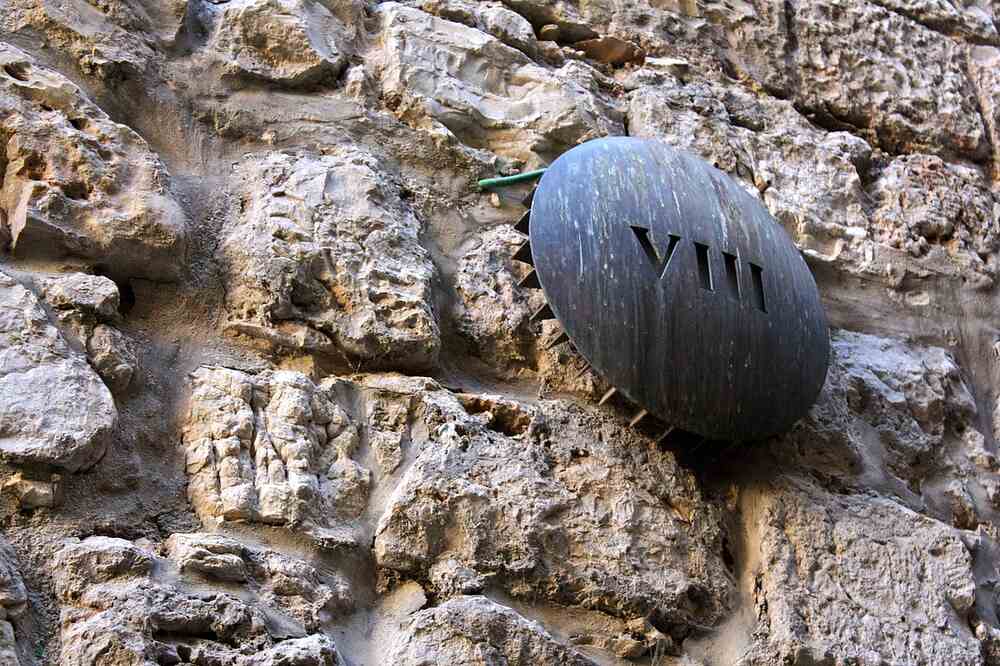
By Kyle Taylor from London, 84 Countries – Israel – Jerusalem – The Old City – 117, CC BY 2.0, https://commons.wikimedia.org/w/index.php?curid=38442511
After passing through the souk and continuing a few meters uphill along the Via Dolorosa, the path veers into a narrow side street. There, about 30 or 40 meters from the Seventh Station, is one of the most discreet places on the route.
On the outer wall of the Greek Orthodox Monastery of St. Charalambos—near the German Hospice of St. John—a small Latin cross carved in stone can be seen, blackened by time and the smoke of candles sometimes lit at its base. Around it are engraved the letters “IC XC NIKA,” a Greek expression meaning: “Jesus Christ conquers.”
This simple sign marks the traditional place where Jesus met the women of Jerusalem who wept as they saw him pass on his way to Calvary. The Gospel according to St. Luke records this moving episode:
“Daughters of Jerusalem, do not weep for me, but weep for yourselves and for your children. For behold, the days are coming when they will say, ‘Blessed are the barren and the wombs that never bore and the breasts that never nursed!’ Then they will begin to say to the mountains, ‘Fall on us,’ and to the hills, ‘Cover us.’ For if they do these things when the wood is green, what will happen when it is dry?” (Lk 23:28-31).
- For more information about this Holy Place, visit the website of the Custody of the Holy Land.
- Location: Via Dolorosa, Jerusalem.
9. Coptic Orthodox Patriarchate

By Berthold Werner – Own work, CC BY-SA 3.0, https://commons.wikimedia.org/w/index.php?curid=14524723
To reach the Ninth Station of the Via Dolorosa, the pilgrim must briefly retrace their steps from the Seventh, turn towards the souk, and after a few meters, ascend a wide staircase that winds up to an elevated point on the route. There, embedded in the outer wall of the Coptic Patriarchate, the worn shaft of a Roman column can be seen: this simple vestige marks the traditional site of Jesus’ third fall.
This point is particularly significant because it is already within sight of the Church of the Holy Sepulchre. Tradition thus wishes to express that Christ fell when Calvary was very near. The end of the road was visible, but human strength seemed to be failing.
Originally, this fall was commemorated within the atrium of the Holy Sepulchre, marked by a stone with an engraved cross. Over the centuries, the memory settled on the current location, next to the arch leading to the Coptic Catholic Patriarchate.
Very close by is also the small Ethiopian monastic complex, built on ancient ruins of the Constantinian basilica. From there, a narrow passage leads to the Holy Sepulchre plaza.
The third fall expresses the extreme physical exhaustion of Jesus. The words of Lamentations illuminate this scene:
“It is good for a man that he bear the yoke in his youth. Let him sit alone and in silence when the Lord has laid it on him; let him put his mouth in the dust—there may yet be hope; let him give his cheek to the smiter and be filled with insults. For the Lord will not cast off forever; but though he cause grief, he will have compassion according to the abundance of his steadfast love” (Lam 3:27-32).
- For more information about this church, visit the website of the Coptic Orthodox Monastery in Jerusalem.
- Location: 8 4, 2030, Dolna Vasilitsa
10-14. Basilica of the Holy Sepulchre

The exterior journey along the Via Dolorosa concludes with the Ninth Station. The subsequent penitential Stations are already inside the Church of the Holy Sepulchre, the place where Christian tradition locates the crucifixion, death, and burial of Jesus Christ.
Typically, from the Ninth Station, one can access it through a door on the left, passing through the Ethiopian monastery on the rooftop and descending through its chapels to the Holy Sepulchre esplanade. If this passage is closed, it will be necessary to go around the complex to the main entrance of the temple.
It should be noted that, due to the constant influx of pilgrims and visitors, there may be slight variations in the exact place to pray each station. In any case, Calvary and the Sepulchre concentrate the last five stations of the Way of the Cross.
- For more information about this church, visit the website of the Monastery of Montserrat.
- Location: Q6HH+9RX Jerusalem, Israel.
10. Jesus is Stripped of His Garments

By User:Mattes – Own work, Public Domain, https://commons.wikimedia.org/w/index.php?curid=16343550
The Tenth Station can be prayed on the esplanade, next to the exterior stairs to the right of the main entrance, under a closed portico. However, it is also common to perform it in the Roman Catholic Chapel of the Nailing to the Cross, already located at the top of Calvary. To do this, upon entering the basilica, the pilgrim immediately turns right and ascends one of the two staircases leading to Calvary.
Much of the current platform is supported by later infrastructure, although the eastern part preserves the original rock.
The episode is narrated by the Gospel according to St. Matthew:
“And when they came to a place called Golgotha (which means Place of a Skull), they offered him wine to drink, mixed with gall, but when he tasted it, he would not drink it. And when they had crucified him, they divided his garments among them by casting lots; then they sat down and kept watch over him there” (Mt 27:33-36).
11. Catholic Chapel of the Crucifixion

By Юкатан – Own work, CC BY-SA 3.0, https://commons.wikimedia.org/w/index.php?curid=5330106
Only a few meters separate the Tenth from the Eleventh Station. The pilgrim is now in the Latin nave of Calvary, restored in 1937 by the architect Antonio Barluzzi. The ceiling mosaics are the work of Pietro D’Achiardi, who preserved a medieval figure of Christ in his composition, thus integrating tradition and artistic renewal.
The silver-plated bronze altar was a gift from Ferdinando I de’ Medici and is attributed to the Dominican Domenico Portigiani (1588). Originally intended for the Stone of Anointing, its panels depict scenes from the Lord’s Passion, inviting reflection and contemplation.
To the right, a window protected by a grille allows a view of the Chapel of the Franks, dedicated to Our Lady of Sorrows and St. John. According to tradition, this would be the place where the Virgin Mary remained during the preparations for the Crucifixion.
At this Eleventh Station, we contemplate the moment when Jesus is nailed to the cross, in the Chapel of the Crucifixion. The evangelist St. Matthew narrates it with sobriety:
“And over his head they put the charge against him, which read, ‘This is Jesus, the King of the Jews.’ Then two robbers were crucified with him, one on his right and one on his left. And those who passed by reviled him, wagging their heads and saying, ‘You who would destroy the temple and rebuild it in three days, save yourself! If you are the Son of God, come down from the cross.’ So also the chief priests, with the scribes and elders, mocked him, saying, ‘He saved others; he cannot save himself. He is the King of Israel; let him come down now from the cross, and we will believe in him’” (Mt 27:37-42).
12. Orthodox Chapel of the Crucifixion

By I, Ondřej Žváček, CC BY 2.5, https://commons.wikimedia.org/w/index.php?curid=25773907
Tradition places the Lord’s death in the eastern part of Calvary, to the left of the Latin nave, within the Greek Orthodox Chapel.
Under the Orthodox altar, a silver disc with a central hole marks the spot where, according to tradition, Christ’s cross was raised. Pilgrims often kneel and touch the rock through this opening, in a gesture of profound veneration. In the time of Emperor Constantine I, this point was marked with a wooden cross; later, in 417, Emperor Theodosius II replaced it with one of gold and precious stones.
To the right of the altar, protected by glass, a fissure in the rock can be seen, which ancient tradition associates with the earthquake mentioned in the Gospel of St. Matthew (27:51), when “the earth shook, and the rocks were split.”
The Gospel narrative introduces us to the culminating moment of the sacrifice:
“Now from the sixth hour there was darkness over all the land until the ninth hour. And about the ninth hour Jesus cried out with a loud voice, saying, ‘Eli, Eli, lema sabachthani?’ that is, ‘My God, my God, why have you forsaken me?’ And some of the bystanders, hearing it, said, ‘This man is calling Elijah.’ And one of them at once ran and took a sponge, filled it with sour wine, and put it on a reed and gave it to him to drink. But the others said, ‘Wait, let us see whether Elijah will come to save him.’ And Jesus cried out again with a loud voice and yielded up his spirit” (Mt 27:45-50).
13. Stone of Anointing

By adriatikus – self-made using a Canon PowerShot A530 camera, CC BY-SA 3.0, https://commons.wikimedia.org/w/index.php?curid=3481778
The Latin altar of the Thirteenth Station is situated between the Eleventh and Twelfth, on Calvary, and is decorated with a wooden bust of Our Lady of Sorrows, offered by Portugal in 1778. This altar is also known as the Stabat Mater, evoking Mary’s sorrow at the foot of the cross.
In Jerusalem, the scene of the Deposition was traditionally linked to the anointing of Jesus’ body, which is today commemorated west of Calvary, at the Stone of Anointing. Before the Crusades, this place corresponded to the Chapel of St. Mary; since the 13th century, it has been explicitly venerated as the site where the Lord’s body was prepared for burial.
The current stone—a polished red block with a Greek inscription—covers the rock on which, according to tradition, Jesus’ body was laid. Ancient pilgrims described at this point a dark stone (black, green, or white) that recalled the anointing. Today, the inscription around it reads:
“The noble Joseph, taking down the sinless body from the wood, came with a clean linen shroud and aromatic spices and buried it in a new tomb.”
The station can be prayed next to the Stabat Mater altar, between the two chapels of Calvary, or on the ground floor, before the Stone of Anointing, where numerous pilgrims bow to touch and kiss the stone in veneration.
The Gospel according to St. Matthew captures the spiritual atmosphere surrounding these moments:
“When the centurion and those who were with him, keeping watch over Jesus, saw the earthquake and what took place, they were terrified and said, ‘Truly this was the Son of God!’ There were also many women there, looking on from a distance, who had followed Jesus from Galilee, ministering to him” (Mt 27:54-55).
14. Holy Sepulchre

By Zairon – Own work, CC BY-SA 4.0, https://commons.wikimedia.org/w/index.php?curid=36736129
To reach the Holy Sepulchre, the pilgrim descends from Calvary, passing by the Stone of Anointing. Very close by is a circular slab protected by an iron grille; according to tradition, from that point the holy women watched Jesus on the cross from afar (cf. Mt 27:55).
In the center of the great rotunda of the Church of the Holy Sepulchre stands the Sepulchre, known in Greek as Anastasis (Resurrection). This sanctuary comprises two main spaces: the Chapel of the Angel and the burial chamber itself. The current structure is the result of the Greek restoration of 1810.
The Chapel of the Angel replaces the ancient antechamber of the tomb. In the center rises a marble pedestal which, according to tradition, contains a fragment of the circular stone that closed the entrance to the tomb.
A small arched opening leads to the burial chamber. After the destruction ordered by Caliph Al-Hakim bi-Amr Allah in 1009, only the original lower parts were preserved; the rest was clad in marble. On the funerary bench on the north side, a marble slab was placed in 1555—now visible and marked by a longitudinal crack—at the initiative of the Franciscan Boniface of Ragusa, then guardian of Mount Zion.
Here the Way of the Cross culminates. Jesus’ body was laid in the new tomb, hewn out of the rock. But the silence of the tomb is not definitive. The empty tomb remains as the great sign of Christian faith:
“He is not here, for he has risen, as he said” (Mt 28:6).
If you want to visit these churches, remember that your Catholic Mass Times app will be your best travel companion. It will help you find local Mass schedules, Confession services, and Adoration times, ensuring that your spiritual pilgrimage is always connected to the sacraments. Download it now.
Pilgrim, if you have the privilege of praying the Way of the Cross along the Via Dolorosa, remember these words of Cardinal Ratzinger:
“Jesus himself interpreted the meaning of the Way of the Cross for us; he taught us to pray it and follow it: the Way of the Cross is the path of losing ourselves, the path of true love. On this path, He has preceded us.”
Let us follow in the footsteps of the Savior. Let us meditate on every step that love made him take for our salvation. Let us give him thanks for his infinite mercy. And let us resolve to renounce all deliberate affection for sin, which was, after all, the cause of the Lord’s terrible passion.
What is the Via Dolorosa?
The Via Dolorosa is the traditional path Jesus walked from the place of his condemnation to Golgotha, where he was crucified. It is located in the Old City of Jerusalem and consists of 14 stations that recall different moments of Christ’s Passion.
Today it is one of the most important Christian pilgrimage routes in the world.
Why is it called Via Dolorosa?
The name comes from the Latin Via Dolorosa, which means “Way of Suffering.” It refers to the suffering Jesus experienced during his journey to the crucifixion: the falls, the weight of the cross, the encounters, and finally, his death on Calvary.
What are the stations of the Via Dolorosa?
The 14 traditional stations are:
-
Jesus is condemned to death
-
Jesus carries the cross
-
Jesus falls for the first time
-
Jesus meets his Mother
-
Simon of Cyrene helps carry the cross
-
Veronica wipes the face of Jesus
-
Jesus falls for the second time
-
Jesus consoles the women of Jerusalem
-
Jesus falls for the third time
-
Jesus is stripped of his garments
-
Jesus is crucified
-
Jesus dies on the cross
-
Jesus is taken down from the cross
-
Jesus is placed in the tomb
The first nine stations are distributed throughout the streets of the Old City, and the last five are located inside the Church of the Holy Sepulchre.
How far did Jesus walk with the cross?
It is estimated that the traditional route of the Via Dolorosa is approximately 600 to 700 meters long.
Although the distance is not long, the context must be considered: narrow streets, an uphill slope, the weight of the cross, and Jesus’ physical condition after the scourging.
How long does it take to walk the Via Dolorosa?
The route can be completed in about 30 minutes if walking without stopping.
However, it usually takes between 1 and 2 hours, especially if praying the stations or visiting the Church of the Holy Sepulchre at a leisurely pace.
On Friday mornings, a Way of the Cross guided by the Franciscans is usually held, which can extend the duration.
How long is the Via Dolorosa?
The Via Dolorosa is approximately 600–700 meters long, depending on the exact starting point taken within the traditional site.
Where does the Via Dolorosa start?
It traditionally begins in the vicinity of the ancient Roman Praetorium, identified today with the area near the Lions’ Gate, in the Muslim Quarter of the Old City.
From there, the route crosses streets and markets until it culminates in the Church of the Holy Sepulchre, where Calvary and the Tomb of Christ are located.
Which Application Helps to Find Mass Schedules in the Holy Land?
The Catholic Mass Times app allows you to locate nearby Catholic churches and check Mass, confession, and adoration schedules in real time during your trip.