Pentecost is the solemnity that concludes the Easter Season and crowns the mystery of the Resurrection and Ascension of Jesus Christ. It is not an autonomous feast, nor is it separate from Easter. On the contrary, it is its fullness, its culmination, and its definitive crowning. In it, the promise Jesus made before His Passion is fulfilled: "The Father will give you another Advocate to be with you forever" (Jn 14:16).
The Catechism of the Catholic Church defines it precisely: on the day of Pentecost, through the outpouring of the Holy Spirit, the Church is made manifest publicly to the whole world (CCC 1076). It is the public birth of the Church and the beginning of the "time of the Church," that period in which Jesus Christ communicates and pours out the fruits of his Paschal Mystery through the sacraments. The Holy Spirit begins to dwell in the hearts of believers to sanctify them from within.
Saint Irenaeus of Lyon expressed it with an image that tradition has not been able to improve upon: "Just as dry wheat cannot become a compact mass and a single loaf unless it is first moistened, so too we, who are many, could not become one in Christ Jesus without this water that comes down from heaven". The Holy Spirit is that water, that gratuitous rain from above, without which we are like a dry log incapable of bearing the fruit of life.
Would you like to find Mass times for Ascension Day at a Catholic church? The Mass Times app shows you up-to-date schedules for more than 110,000 churches in 200 countries. Download it now.
Pentecost: Biblical Meaning
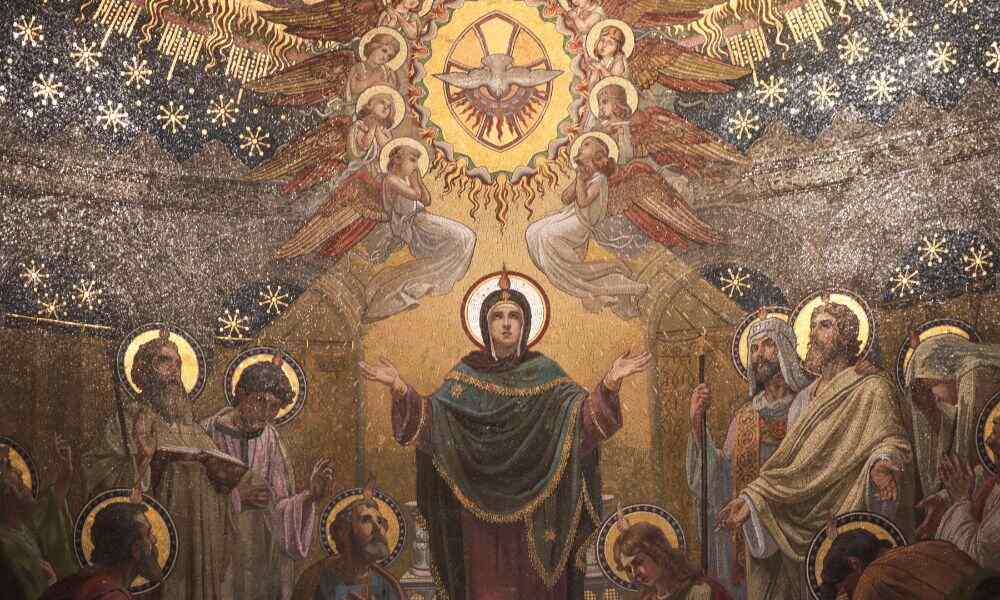
The account of Christian Pentecost is found in Acts 2:1-11. The apostles and Mary were gathered in the Upper Room in Jerusalem when "suddenly a sound like the blowing of a violent wind came from heaven and filled the whole house where they were sitting". Tongues as of fire rested on each of them, and all were filled with the Holy Spirit, beginning to speak in different tongues.
The Holy Spirit manifests Himself in those elements that, in the Old Testament, accompanied the presence of God: wind and fire. Fire appears in Sacred Scripture as the love that penetrates everything and as a purifying element. The impetuous wind expresses the new force with which divine Love bursts into the Church and into souls. And Saint Cyril of Jerusalem precisely describes the resulting action: the Spirit "comes to save, to heal, to teach, to advise, to strengthen, to console, to enlighten".
But the meaning of Pentecost in the Bible has deeper roots. Fifty days before, the Jewish Passover commemorated the exodus from Egypt. Fifty days later, Shavuot celebrated the giving of the Law on Sinai, which implied the constitution of Israel as the People of God. The event in the Upper Room assumes that structure and brings it to its fulfillment: the old law engraved on stone on Sinai is replaced by the law of grace engraved directly on hearts, fulfilling Ezekiel's prophecy: "I will give you a new heart and put a new spirit in you" (Ez 36:26).
Pentecost: Theological and Spiritual Meaning
The deepest meaning of Pentecost is ecclesiological: it is the public birth of the Church of Jesus Christ and the formal beginning of its evangelizing mission among all nations.
The conciliar decree Ad Gentes states it precisely: the Church was essentially catholic on the very day of Pentecost and will be so uninterruptedly until the day of the Parousia, because it has been sent by Christ's command to the whole human race. The outpouring of the Holy Spirit introduces the apostles into a state of apostolic maturity: they pass from reclusion out of fear of the Jews to the bold and public proclamation of the Gospel before multitudes of people from all nations.
Saint Irenaeus describes it with his usual theological depth: the Holy Spirit descended upon the Son of God made Son of Man so that, remaining in Him, He might dwell in humankind and rest upon men, "thus accomplishing in man the will of the Father and renewing him from the old condition to the new, created in Christ".
The Paraclete was not a one-time gift for the apostles of the first hour. The meaning of Pentecost is that the Holy Spirit continuously sanctifies the Church and every soul, through innumerable inspirations which are, according to Saint Francis de Sales, "all the attractions, movements, reproaches and interior remorse, lights and knowledge that God works in us to awaken us, move us, push us and draw us to holy virtues".
Pentecost: Meaning as the Antithesis of Babel
One of the most illuminating keys to understanding the meaning of Pentecost is its contrast with the account of the Tower of Babel in Genesis.
In Babel, humanity, driven by pride and arrogance, sought to reach heaven by its own means. The result was the confusion of tongues, mutual incomprehension, hostility, and the dispersion of peoples. Sin fragmented the original unity of the human family.
In the Upper Room, the exact opposite occurs. The Holy Spirit descends as a force of divine communion that unites without uniformity: it does not annul the spiritual or cultural physiognomy of peoples, but rather makes it possible for men of radically different languages and nations to hear, understand, and embrace the wonders of God, each in their own tongue. The Holy Spirit makes all tongues proclaim the same wonders. He promotes unity in diversity, catholicity properly speaking.
Saint Irenaeus expresses it with an ecclesial image of great beauty: the Holy Spirit offers the Father at Pentecost "the first fruits of all nations"; all peoples, in their own language and from their own culture, begin to belong to the universal Church of Christ.
The Paraclete
Jesus called the Holy Spirit the "Paraclete", the Comforter, the Advocate, the one who is called alongside (Jn 14:16). This designation illuminates one of the most existential aspects of the meaning of Pentecost: the difference between the consolation offered by the world and that which comes from heaven.
In the face of life's difficulties, human beings seek earthly consolations. But these act like anesthetics: they offer temporary relief on the surface of the senses, dulling the pain without curing its root. The consolation of the Holy Spirit is radically different because it acts directly on the spiritual plane, descending to the innermost center of the human heart. Saint Bonaventure precisely affirmed: "Where there is greater tribulation, the Spirit brings greater consolation". This is unlike the logic of the world, which flatters man in prosperity but abandons him in adversity.
The interior action of the Holy Spirit is also manifested in what Pope Francis describes as "the healing of memory". Human beings are prone to harboring feelings of guilt, remorse for past failings, and emotional wounds that hinder their spiritual path. The evil spirit encourages focusing on one's own mistakes to generate distrust and bitterness.
Against this inclination, the Holy Spirit acts as the living memory of God in the believer, reminding him of his fundamental identity: "You are a child of God, you are a unique and precious creature, you are loved even in the midst of your frailties". By instilling the certainty of God's paternal love, the Spirit reorders the soul's memories, teaches the path of forgiveness, and grants the supernatural strength to start anew with hope.
Pentecost: Meaning of the 7 Gifts of the Holy Spirit
The Holy Spirit, in addition to comforting us, perfects and sanctifies us. He does so through the seven gifts that, according to the prophet Isaiah (Is 11:1-3), rested upon the Messiah and are communicated to all His members. These are supernatural habits infused by God that make the soul docile to promptly follow divine inspirations, perfecting the theological and cardinal virtues.
Saint Josemaría Escrivá pointed out that the sanctification and apostolic efficacy of Christian life depend on correspondence to the promptings of the Holy Spirit and that a soul docile to these gifts acts as a living instrument in the hands of God.
Gift of Wisdom: allows one to judge all human realities from a divine perspective, savoring God through connaturality. It perfects charity and produces the fruits of peace and spiritual joy. It is the most perfect and excellent of all gifts.
Gift of Understanding: illuminates the mind to penetrate the depths of revealed truths with an intuition that transcends natural reasoning. It perfects faith and allows one to see the divine reality hidden beneath the veils of the sacraments, Scriptures, and liturgy.
Gift of Knowledge: provides the supernatural instinct to rightly judge created things in their relationship with God, discovering in them the Creator's imprint and preserving the soul from the deceptive charm of creatures. It is the "science of the saints".
Gift of Counsel: perfects prudence, allowing the soul to quickly and surely intuit God's will in the moral crossroads of life, where human reasoning would arrive too late. It is the supernatural instinct of discernment.
Gift of Fortitude — strengthens the soul to practice heroic virtues with invincible trust in God's omnipotence. It transforms terrified fishermen into brave martyrs — exactly what happened at Pentecost with the apostles.
Gift of Piety: excites in the will a filial affection for God as Father and a feeling of universal fraternity towards all men as children of the same Father. It is the gift that communicates to the soul the spirit of God's family.
Gift of Fear of the Lord: infuses in the soul a perfect filial fear before the divine majesty, not the fear of a slave fleeing punishment, but that of a child who avoids offending his Father out of love. It is the basis and foundation upon which all other gifts are built.
The 12 Fruits of the Holy Spirit in the Christian Life
When the soul docilely responds to the action of the gifts, it produces fruits, that is, exquisite acts of virtue that visibly manifest that the Holy Spirit dwells and acts within it. Saint Paul enumerates them in Galatians 5:22-23; the Latin Vulgate expands them to twelve.
Charity: the supreme love that moves one to love God above all things and one's neighbor out of love for Him. It is the foundation and root of all other fruits.
Joy: a state of inner joyful peace that remains constant even amidst external tribulations. It is not extinguished by suffering — it grows through it.
Peace: the tranquility of spiritual order that derives from total trust in God's Providence. It is the serene possession of the beloved object par excellence.
Patience: the supernatural capacity to endure daily sufferings and offenses without harboring anger or despair.
Longanimity: perseverance and greatness of spirit to steadfastly await long-term spiritual goods, without faltering in the prolonged practice of good.
Goodness: the permanent disposition to actively and unconditionally do good to others, in imitation of Christ, who went about doing good and healing.
Benignity: the sweetness and gentleness in dealing with one's neighbor that reflects God's tenderness, making one sociable and affable even in the face of rudeness from others.
Meekness: the ability to control anger in the face of provocations and respond with serenity, opposing the resentment that seeks revenge.
Fidelity: unwavering loyalty to divine promises and assumed commitments, which glorifies God who is truth.
Modesty: decorum and moderation in dress, speech, and behavior, which reflects inner calm and preserves the dignity of the soul.
Continence: the ordered control of bodily appetites and passions through the mastery of reason enlightened by faith.
Chastity: the purity of soul and body that makes the Christian a living temple of the Holy Spirit, integrating human sexuality in a holy and ordered manner.
Pentecost: Meaning of the Presence of the Blessed Virgin Mary
No understanding of the meaning of Pentecost is complete without Mary. The Acts of the Apostles are precise: "All of them were devoting themselves to prayer, together with the women and Mary the mother of Jesus" (Acts 1:14). At the center of the Upper Room, in the heart of the first praying community, was the Mother of God.
John Paul II formulated it in the encyclical Dominum et vivificantem: "The era of the Church began with the coming, that is, with the descent of the Holy Spirit upon the Apostles gathered in the Upper Room in Jerusalem together with Mary, the Mother of the Lord". Mary's Pentecost is, for Marian theology, a second Advent: just as she waited in silence and prayer for the coming of the Word in the Incarnation, she now waits in silence and prayer for the outpouring of the Spirit upon the nascent Church.
The reason for her central presence is not only historical. Mary received the Holy Spirit with a unique fullness on the day of Pentecost because her heart was the purest and most detached, the one that incomparably loved the Most Holy Trinity the most. The Paraclete descended upon her soul in a new way, making her, in the words of Saint Augustine recorded by tradition, "like the heart of the nascent Church".
Saint Josemaría Escrivá pointed out that to better deal with the Holy Spirit, nothing is as effective as approaching Saint Mary, who knew how to second His inspirations like no other creature. The apostles understood this, which is why we see them with her in the Upper Room before Pentecost.
Pius XII formulated it in the encyclical Mystici Corporis: Mary "through her most efficacious prayers, obtained that the Spirit of the divine Redeemer, already granted on the Cross, should be communicated with His prodigious gifts to the Church, newly born on the day of Pentecost".
How to Respond to the Holy Spirit: The Three Fundamental Means
The Paraclete who descended upon the Upper Room continues to act today in every soul. Saint Josemaría Escrivá points out three fundamental realities for responding to His promptings:
- Docility
The Holy Spirit is the one who, with His inspirations, gives a supernatural tone to our thoughts, desires, and works. The docile soul perceives His voice in prayer, in reading the Gospel, in advice received, in inner remorse. The undocile soul quenches the Spirit (1 Thess 5:19) and deprives its virtues of the divine impulse they need to flourish.
- Life of Prayer
Docility is born of love, and love leads to interaction, conversation, and friendship. The Holy Spirit leads to intimacy with the Triune God. Frequent interaction with the Paraclete — trusting in Him, asking for His help, feeling Him near — is the path by which the human heart expands and acquires a greater desire to love God and all creatures through Him.
- Union with the Cross
In the life of Christ, Calvary preceded the Resurrection and Pentecost. This same process must be reproduced in every Christian. The Holy Spirit is the fruit of the Cross, of total surrender to God and self-renunciation. He cannot be received in fullness without passing through the narrowness of the Cross.
Let us ask the Blessed Virgin for the grace to be faithful to the Holy Spirit, to dispose our hearts to His action, to listen to Him attentively, and to obey Him promptly.
Hymn Veni Creator Spiritus
Come, Creator Spirit,
visit the souls of your faithful,
fill with your divine grace
the hearts you have created.
You, whom we call Paraclete,
gift of God Most High,
living fountain, fire,
charity and spiritual anointing.
You pour out upon us the seven gifts;
You, finger of the Father's right hand;
You, faithful promise of the Father;
who inspire our words.
Illuminate our senses;
infuse your love into our hearts;
and, with your perpetual help,
strengthen the weakness of our body.
Drive the enemy far from us,
grant us peace soon,
be our director and our guide,
so that we may avoid all evil.
Through You may we know the Father,
and also reveal the Son to us;
May we believe in You, His Spirit,
throughout the ages of ages.
Glory to God the Father,
and to the Son who rose,
and to the Consoling Spirit,
throughout the ages of ages. Amen.


You can use the Mass Times app to find the nearest Catholic church with schedules for Mass, Confession, and Adoration. It will surely be useful! Download it now.
Would you like to live Pentecost with fervor? Check out these articles that can help you:
- What is the Easter Season and How Long Does It Last?: Complete guide to the Easter Season: meaning, Sundays, liturgical signs, Via Lucis, Regina Coeli, and the 2026 celebration calendar.
- Who is the Holy Spirit and What Does He Do?: The Holy Spirit is the Great Unknown. Who is the Holy Spirit and what does He do, what does the Bible say about Him, what does the Catholic Church teach?
- The 7 Gifts of the Holy Spirit Explained: What are the gifts of the Holy Spirit for? An explanation according to the Bible and the Catechism, and how they act in the spiritual life of the baptized.
- The 12 Fruits of the Holy Spirit: The 12 fruits of the Holy Spirit explained one by one: what they are, how they differ from the gifts, and what they produce in the life of a Christian.
What is Pentecost and when is it celebrated?
Pentecost is the solemnity of the Holy Spirit that closes the Easter season, celebrated fifty days after Easter Sunday — always on a Sunday. In 2026 it falls on May 24. It is a movable feast: its date varies each year depending on when Easter falls. The Monday following Pentecost Sunday, the memorial of Mary, Mother of the Church, is celebrated.
Pentecost: Biblical Meaning
In the Bible, Pentecost appears in two dimensions. In the Old Testament it is the "feast of weeks" or Shavuot (Ex 34:22; Lev 23:15-21), which celebrated the harvest and the giving of the Law on Sinai. In the New Testament it is the event narrated in Acts 2:1-11: the descent of the Holy Spirit in the form of a mighty wind and tongues of fire upon the apostles gathered with Mary in the Upper Room in Jerusalem.
Pentecost: Theological Meaning
Pentecost Day signifies the fullness of the Paschal Mystery. It is not a feast separate from the Resurrection and Ascension, but their crowning. It signifies the fulfillment of the promise of the Advocate, the public birth of the Church, the beginning of the sacramental economy, and the inauguration of the "time of the Church," in which Christ communicates the fruits of his Passion through the sacraments (CCC 1076).
What is the difference between Pentecost and Easter?
Easter celebrates the Resurrection of Christ — the triumph over death. Pentecost celebrates the outpouring of the Holy Spirit upon the Church — the gift of the Risen One to His disciples. They are not independent feasts but moments of a single Paschal Mystery: the Resurrection inaugurates it, the Ascension glorifies it, and Pentecost pours it out upon humanity. Without Easter there is no Pentecost; without Pentecost, Easter does not reach its full fruits.
Pentecost: Catholic Meaning
In the Catholic Church, Pentecost is a first-rank solemnity placed at the end of the Easter season. It is celebrated with a Vigil Mass and a Mass during the Day, with red vestments, the mandatory Veni Sancte Spiritus sequence, and proper readings. At the end of the Mass during the Day, the Paschal Candle is extinguished, liturgically marking the end of the Easter fifty days. The following Monday, the memorial of Mary, Mother of the Church, is celebrated.
Pentecost: Meaning for Catholics Today
For Catholics today, the meaning of Pentecost is that the same Holy Spirit who descended upon the Upper Room continues to act in the Church and in every baptized soul. The seven gifts and the twelve fruits of the Holy Spirit are living supernatural realities that perfect the virtues of the Christian and equip him for mission.
What role did Mary play in Pentecost?
Mary was at the center of the Upper Room, praying with the apostles before the descent of the Holy Spirit (Acts 1:14). Theological tradition recognizes her as "the heart of the nascent Church" and as the one who, through her prayers, obtained that the Spirit of the Redeemer be communicated to the Church with His prodigious gifts (Pius XII, Mystici Corporis). She received the Holy Spirit with a unique fullness that day — the greatest of all creatures — and since then actively collaborates with the Paraclete in the sanctification of souls.
Where can you find online broadcasts of today’s Mass for Pentecost Sunday?
Several institutions broadcast the Mass of the Ascension live: EWTN in Spanish (ewtn.com), Vatican News in Spanish (vaticannews.va), and the YouTube channels of major Spanish-speaking cathedrals — such as the Cathedral of Mexico, the Cathedral of Buenos Aires, or the Cathedral of Madrid. Many parishes also broadcast their Masses on their own YouTube channels or Facebook pages.
How much time is there between Easter and Pentecost?
Between Easter Sunday and Pentecost Sunday there are exactly fifty days, the "Paschal fifty days" or Easter Season. This period is lived liturgically as a single, prolonged feast day, the "great Sunday" of the Church. In 2026, Easter Sunday was April 5th and Pentecost falls on May 24th.